# Table of Contents
- [Welcome](#welcome)
- [Explain Like I'm Five](#explain-like-i-m-five)
- [Release Notes](#release-notes)
- [Vana Token Overview](#vana-token-overview)
- [Vana Whitepaper](#vana-whitepaper)
- [What is Vana?](#what-is-vana-)
- [For Data Consumers](#for-data-consumers)
- [For Developers](#for-developers)
- [Network Information](#network-information)
- [Governance](#governance)
- [DataDAO Rewards](#datadao-rewards)
- [For Explorers](#for-explorers)
- [DataDAOs](#datadaos)
- [Quickstart](#quickstart)
- [For Data Contributors](#for-data-contributors)
- [Contract Addresses](#contract-addresses)
- [ChatGPT DataDAO Example](#chatgpt-datadao-example)
- [Ecosystem Partners](#ecosystem-partners)
- [Bridging on Vana](#bridging-on-vana)
- [Network](#network)
- [Minimum Requirements](#minimum-requirements)
- [Data Liquidity Pool & DLPToken](#data-liquidity-pool-dlptoken)
- [L1 Validator](#l1-validator)
- [VanaPool](#vanapool)
- [Data Registry](#data-registry)
- [Cycle 6 Rewards Distribution Example](#cycle-6-rewards-distribution-example)
- [VanaPool Entity](#vanapool-entity)
- [Cycle 2 Rewards Distribution Example](#cycle-2-rewards-distribution-example)
- [FAQ](#faq)
- [TEE Pool](#tee-pool)
- [Smart Contracts](#smart-contracts)
- [Vana Docs](#vana-docs)
- [Release Notes](#release-notes)
- [DLP Root Epoch](#dlp-root-epoch)
- [Validators](#validators)
- [Cycle 3-5 Rewards Distribution Example](#cycle-3-5-rewards-distribution-example)
- [Proof of Contribution](#proof-of-contribution)
- [DLP Root Core](#dlp-root-core)
- [VanaPool Staking](#vanapool-staking)
---
# Welcome
###
✍️ Introduction
[](#️-introduction)
* [What is Vana?](https://docs.vana.org/docs/what-is-vana)
* [Explain Like I'm Five](https://docs.vana.org/docs/explain-like-im-five)
* [Ecosystem](https://docs.vana.org/docs/overview)
###
🚀 Get Started
[](#-get-started)
* [For Explorers](https://docs.vana.org/docs/for-explorers)
* [For Developers](https://docs.vana.org/docs/for-developers#/)
* [For Data Contributors](https://docs.vana.org/docs/for-data-contributors)
* [For Data Consumers](https://docs.vana.org/docs/for-data-consumers)
###
🎓 Concepts
[](#-concepts)
* [Network](https://docs.vana.org/docs/network-overview)
* [DataDAOs](https://docs.vana.org/docs/data-liquidity-pools-dlps)
* [DataDAO Rewards](https://docs.vana.org/docs/datadao-rewards)
* [Validators](https://docs.vana.org/docs/validators)
* [Proof of Contribution](https://docs.vana.org/docs/proof-of-contribution)
* [Smart Contracts](https://docs.vana.org/docs/smart-contracts)
* [Data Ingress](https://docs.vana.org/docs/data-ingress)
###
📘 Tutorials
[](#-tutorials)
* [How to create a DataDAO?](https://docs.vana.org/docs/how-to-create-a-data-liquidity-pool)
* [How to create a wallet?](https://docs.vana.org/docs/how-to-create-a-wallet-on-vana)
###
🔮 Other
[](#-other)
* [FAQ](https://docs.vana.org/docs/faq)
###
🏛️ Foundation Programs
[](#️-foundation-programs)
* [Vana Academy](doc:vana-academy)
* [Vana Grow](doc:vana-grow)
* [Vana Visionaries](doc:vana-visionaries)
Updated about 2 hours ago
* * *
---
# Explain Like I'm Five
What is Vana?
[](#what-is-vana)
-----------------------------------
Vana lets people take back control of their personal data. Right now, big companies like Facebook and Google collect your data and make money from it. But with Vana, you get to decide what happens to your data — and even get paid when it's used!
How does it work?
[](#how-does-it-work)
-------------------------------------------
Vana turns your data into something valuable by putting it into special data pools called DataDAOs. These pools make your data easy to share, while keeping it private and safe. It’s like putting your data into a bank where you can potentially earn rewards when others use it.
What’s the problem with data today?
[](#whats-the-problem-with-data-today)
------------------------------------------------------------------------------
Big companies use our data all the time, but we don’t get any returns or control over how it’s used. We’re giving away our valuable data for free!
How does Vana fix this?
[](#how-does-vana-fix-this)
-------------------------------------------------------
* **You own your data:** You get to decide who uses it and how.
* **You earn rewards**: Every time your data is used, you get a share of revenue.
* **It’s safe:** Your data is private and protected.
Key Parts of Vana:
[](#key-parts-of-vana)
---------------------------------------------
* **DataDAOs:** These are like big pools where you can put your data. When people want to use it, you get paid.
* **Proof-of-Contribution:** This is how Vana makes sure your data is valuable. It’s like a special stamp that shows your data is important and can be used to help train AI models.
* **Governance:** When you share your data, you also get the power to help make decisions on how the network runs. You’re not just contributing—you’re in charge too.
An Example:
[](#an-example)
-------------------------------
Imagine you’ve collected data from your fitness app. Normally, the app company uses that data without your permission. With Vana, you contribute your fitness data to a DataDAO. When a company wants to use it to train a health AI, they must pay you, and you get to control how your data is used.
Wrap-up:
[](#wrap-up)
-------------------------
Vana lets you keep control over your data and share rewards when it’s used. Instead of giving it away for free, you can now turn your data into something valuable — safely and privately.
Ready to join Vana and start owning your data?
Updated 5 months ago
* * *
---
# Release Notes
April 11th, 2025
added
March 31st, 2025
February 7th, 2025
improved
January 29th, 2025
added
January 26th, 2025
added
January 25th, 2025
fixed
January 22nd, 2025
improved
January 7th, 2025
improved
November 14th, 2024
improved
November 4th, 2024
improved
---
# Vana Token Overview
An open and decentralized protocol for data sovereignty, Vana unlocks user-owned data as a new digital asset class in the global AI economy.
The Vana network is an EVM-compatible layer-1 blockchain designed to restore individual control over personal data and enable user-owned AI through private and secure data transactions at individual and collective levels. In an era where artificial intelligence is driving immense value from user data, Vana ensures that data creators—individuals—capture a fair share of the value generated while enabling researchers to access unique datasets.
By combining blockchain coordination, privacy-preserving technologies, and tokenized economic incentives, Vana enables users to maintain full control over their data while contributing to collective data assets that power AI and other applications.
The VANA tokenomics are designed to align incentives across all participants in the Vana network—validators, DLP creators, stakers, and community members. By prioritizing early data liquidity, supporting robust contributions through DLPs, and fostering decentralized governance, Vana aims to unlock the full potential of user-owned data and AI technologies.
With clear incentives for participation, carefully planned emissions, and a focus on long-term sustainability, Vana is creating a vibrant, self-sustaining ecosystem where individuals and communities can realize the true value of their data. The $VANA token serves as the foundation for this transformative vision, empowering users to take control of their data while driving innovation in AI and beyond.
| Category | |
| --- | --- |
| Ticker | $VANA |
| Total Supply | 120,000,000 $VANA |
| % to Community | 66.9% |
| Float | 25.1% |
| Token Standard | Vana L1: Native $VANA, Wrapped Version as ERC-20 on Ethereum |
Token Utility
[](#token-utility)
====================================
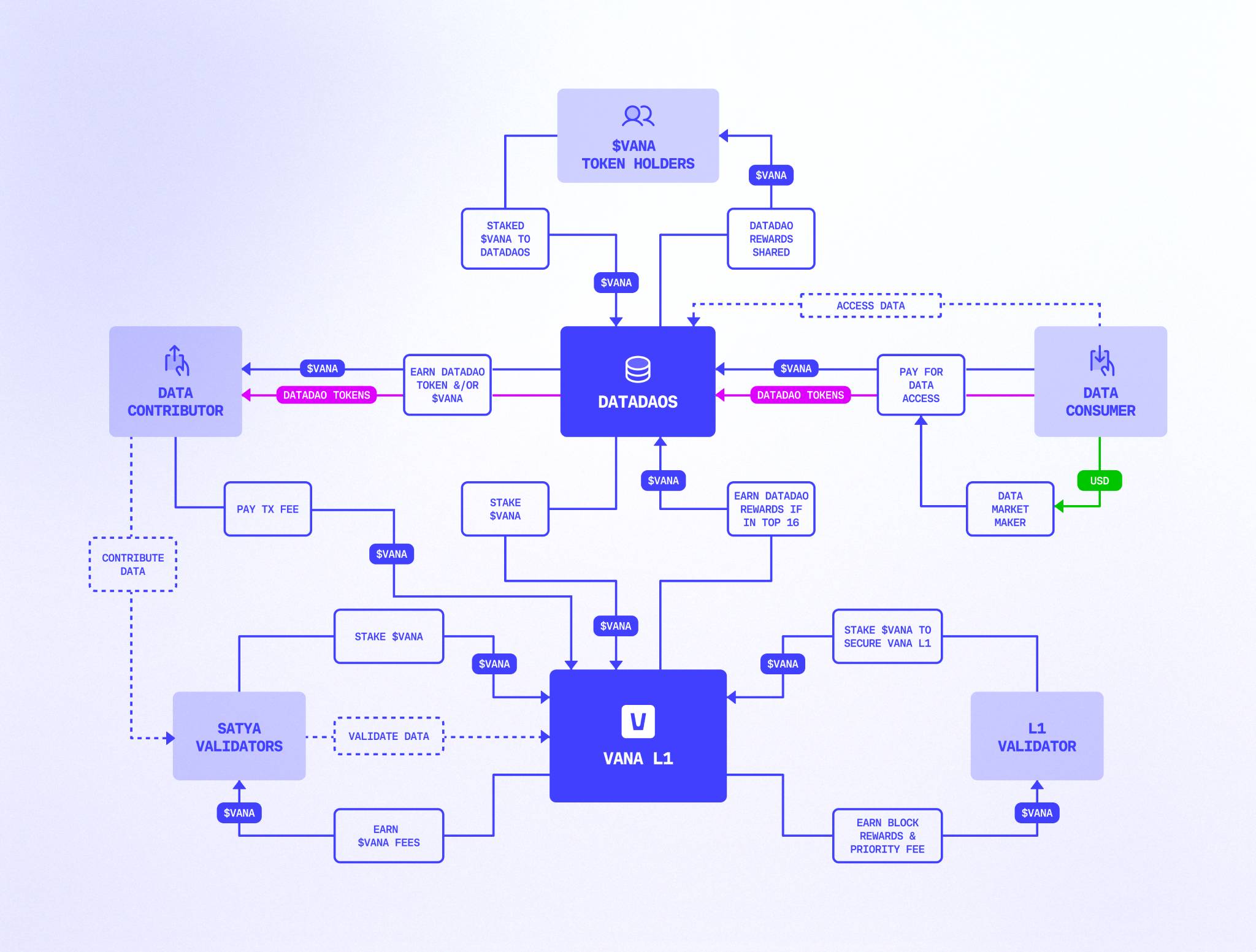
$VANA is the native token of the Vana Network, powering its ecosystem and supporting secure, decentralized data transactions. It plays a central role in the network's multi-token ecosystem through the following use cases:
Network Security
[](#network-security)
------------------------------------------
Validators stake $VANA to secure the blockchain, ensuring reliable transaction validation and operational stability. Validators receive staking rewards for their role in maintaining the network's integrity. However, during Phase 1 of the network, all Layer 1 validator rewards will be redirected to a public goods fund to support the broader ecosystem.
Transaction Fees
[](#transaction-fees)
------------------------------------------
$VANA is used to pay for all network transactions, including data-related operations, smart contract executions, and interactions with DataDAOs. This establishes $VANA as the medium of exchange for activities within the ecosystem.
Data Validators Staking
[](#data-validators-staking)
--------------------------------------------------------
Users stake $VANA in Data Validators and earn emissions to support network in adding more valuable data capital to the ecosystem.
Default Data Access Currency
[](#default-data-access-currency)
------------------------------------------------------------------
Accessing datasets managed by DataDAOs uses $VANA by default, which can be swapped for other tokens as desired by the buyer, seller, or agent. These tokens unlock datasets for use in applications by researchers, developers, and businesses.
Trading Pair
[](#trading-pair)
----------------------------------
$VANA serves as the primary trading pair for all tokens issued by DataDAOs, facilitating seamless exchange and interoperability across the ecosystem.
Governance
[](#governance)
------------------------------
$VANA holders actively participate in the decentralized governance of the Vana Network, voting on proposals and influencing key decisions. This supports decentralized decision-making and broad community involvement.
At genesis, the Vana Foundation is responsible for the stewardship of the VANA token and treasury. Governance of the treasury will expand to other network stakeholders and contributors through the Vana DAO. Governance will progressively transition to community control, ensuring a fair and inclusive approach to managing the ecosystem.This will expand the scope of decision-making, allowing participants to help shape the network’s direction and manage key parameters, such as reward structures and emissions.
Data Token Ecosystem
[](#data-token-ecosystem)
--------------------------------------------------
The Vana Network supports a dynamic ecosystem where DataDAOs can issue their own tokens tied to specific datasets or rights. $VANA serves as the foundational token that interconnects these activities, fostering collaboration and enabling a robust data economy.
Vana Supply and Distribution
[](#vana-supply-and-distribution)
==================================================================
The **total supply of VANA is capped at 120 million tokens**, distributed as follows:
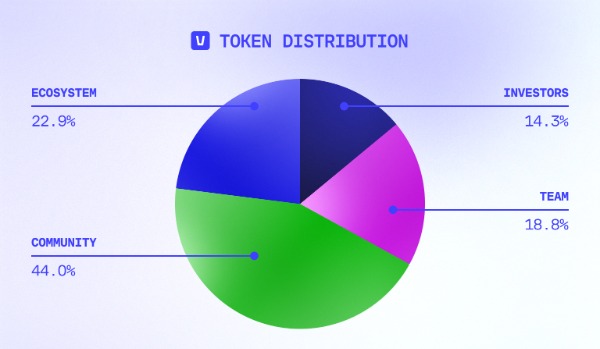
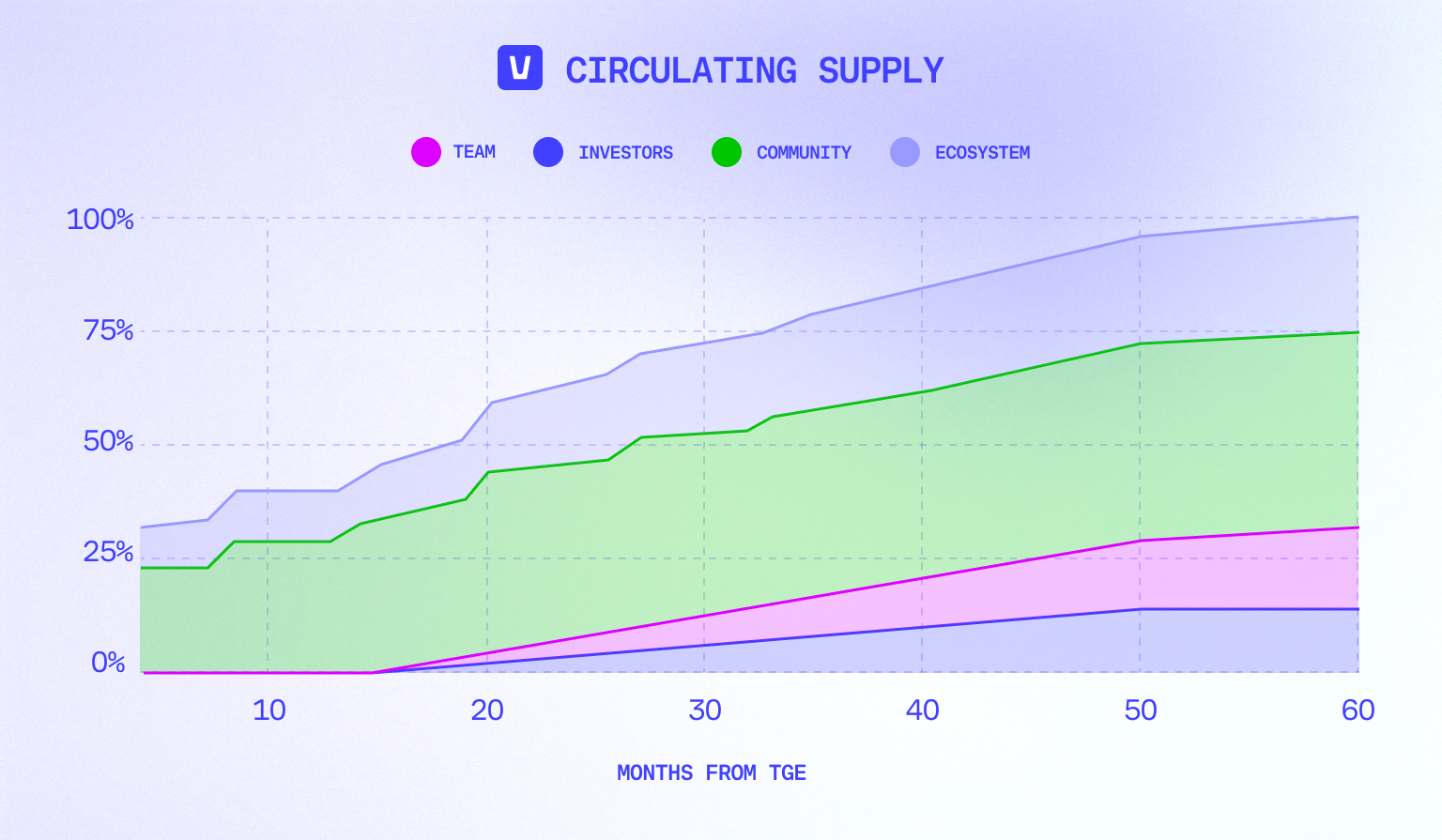
| Category | Allocation | % Supply Released at TGE | Lock-up (Months) | Unlock (Months) | Fully Unlocked (Months) |
| --- | --- | --- | --- | --- | --- |
| **Core Contributors** | 18.8% | 0.00% | 12 | 48 | 60 |
| **Community** | 44.0% | 20.3% | 0 | 36 | 36 |
| **Investors** | 14.2% | 0.00% | 12 | 36 | 48 |
| **Ecosystem** | 22.9% | 4.8% | 0 | 48 | 48 |
Community
[](#community)
----------------------------
The Community allocation focuses on fostering participation and rewarding contributors in the Vana Network. This includes rewards for high-quality data contributions to DataDAOs, airdrops to early adopters, and support to developers building on Vana. Future incentives will ensure sustained engagement and community alignment with Vana’s vision.
Ecosystem
[](#ecosystem)
----------------------------
The Ecosystem allocation will ensure sustainability of the Vana protocol through grants and rewards that drive long-term growth of the Vana network. Grants will be allocated to activities including DataDAO bootstrapping, support for new DataDAO tokens, network partnerships and block rewards to incentivize network decentralization, innovation and adoption.
Investors
[](#investors)
----------------------------
Early supporters with a 4 year vest (1-year cliff plus 3 year unlock).
Core Contributors
[](#core-contributors)
--------------------------------------------
The team that has worked tirelessly to help bring Vana from concept to reality, and will continue to provide support for the development of protocol. All tokens distributed as part of the Core Contributors allocation are subject to a 5 year vest (1-year cliff and 4 year unlock).
Phases
[](#phases)
======================
VANA emissions are structured to align with the network’s growth trajectory, distributed across four 6-month phases:
**Phase 1: Build Data Liquidity (0-6 months)**
* Focus: Bringing data contributors and Data DAOs ; Incentivize DataDAOs and onboard users.
* Emissions: Majority directed to DataDAO creators and rewards to early data contributors to bootstrap adoption.
**Phase 2: Accelerate AI Innovation and Applications (6-12 months)**
* Focus: Encourage creation of AI agents with collectively owned models.
* Emissions: Begin incorporating fee revenue to fund emissions; rewards for high-value data contributors and developers creating new AI applications.
**Phase 3: Decentralization and Governance (12-18 months)**
* Focus: Transition to community governance and increase user rewards.
* Emissions: Begin tapering emissions, relying more on transaction fees.
Enable community-driven control over rewards and key parameters.
**Phase 4: Network Expansion (18-24 months)**
* Focus: Drive ecosystem sustainability and improve cross-DLP integrations.
* Emissions: Shift to demand-driven rewards with steady-state deflation.
Updated 20 days ago
* * *
---
# Vana Whitepaper
Updated 4 months ago
* * *
---
# What is Vana?
What is Vana?
[](#what-is-vana)
-----------------------------------
Vana is the first network for user-owned data. It transforms how data is owned, shared, and monetized. The Vana L1 enables users to pool their data in [DataDAOs](https://docs.vana.org/docs/data-liquidity-pools-dlps)
while maintaining control and privacy.
Developers can leverage these decentralized datasets to create next-generation applications, such as AI models and data-driven dApps.
The "Why"
[](#the-why)
--------------------------
**The problem:** In today’s data economy, tech giants profit from the data you generate, while you get nothing in return. Reddit for example, earns $200M from selling user-generated content as AI training data. Worse, you have no say in how your data is used or who benefits from it.
**The solution:** Vana changes that by giving you ownership over your data. Through DataDAOs, you can contribute, tokenize, and share your data. You decide how it’s used, and you get rewarded for it. With Vana, data becomes an asset that empowers you — whether it’s used in AI development or other applications.
The "How"
[](#the-how)
--------------------------
Here’s how Vana works for you:
1. **Contribute Data:** Users contribute data to DataDAOs. Contributions range from social media data to IoT and sensor data, all securely stored encrypted off-chain.
2. **Tokenize:** Validated data is tokenized, enabling secure data usage across different decentralized applications, particularly for AI model development.
3. **Earn and Govern:** Users gain governance rights in different DataDAOs, influencing decisions about data use and getting a share of profit when data is used.
Vana leverages blockchain to ensure transparency, security, and decentralization in how data is owned and shared.
A Quick Example
[](#a-quick-example)
----------------------------------------
Imagine you’ve been tracking your health data for years. You contribute this data to a Data Liquidity Pool on Vana. It gets tokenized, verified, and becomes a valuable asset in the hands of AI developers who use it to build life-saving medical models.
As these models grow and generate revenue, you earn a share of that — finally gaining financial returns from the data you’ve been giving away for free. Plus, you’re part of the decision-making process, helping shape how this data is used in the future of healthcare.
The Benefits
[](#the-benefits)
----------------------------------
* **Data Ownership:** Users maintain ownership of their data, with full control over how it’s used in applications.
* **Tokenized Data:** Data is transformed into a verifiable, tradable asset for decentralized AI and data-driven applications.
* **Privacy & Security:** Zero-Knowledge Proofs (ZKP) and Trusted Execution Environments (TEEs) ensure the privacy and security of the data contribution.
* **Decentralized Governance:** Participants influence ecosystem rules and data pool operations through on-chain voting.
Take Control of Your Data
[](#take-control-of-your-data)
------------------------------------------------------------
Vana is more than just a platform — it’s a movement to help you take back control of your data and become a key player in the digital economy.
By joining Vana, you gain ownership, governance, and return from the data you generate every day.
Updated 5 months ago
* * *
---
# For Data Consumers
###
How to participate:
[](#how-to-participate)
* **Browse and purchase access** to datasets from the Vana ecosystem that fit your AI model development needs.
* Use Vana’s infrastructure for **AI training and data analysis**, ensuring compliance with ethical data-sharing practices.
* Collaborate with **dataDAOs** to refine models and improve data quality for better AI insights.
###
Why participate?
[](#why-participate)
By utilizing the Vana network, you gain access to high-quality datasets in a transparent, user-consent-driven environment, ensuring ethical AI development while maintaining data integrity.
Updated 5 months ago
* * *
---
# For Developers
###
How to participate:
[](#how-to-participate)
* Check out our [**How to Create a DataDAO**](https://docs.vana.org/docs/how-to-create-a-data-liquidity-pool)
guide for step-by-step instructions on creating your own data liquidity pools.
* Our [GitHub](https://github.com/vana-com/)
is a great place to see a collection of our projects.
* Explore our **developer documentation and APIs** or [Discord](https://discord.gg/withvana)
to start building directly on Vana.
* Join **hackathons** or participate in bounty programs for additional rewards and visibility in the community.
###
Why participate?
[](#why-participate)
Building on Vana opens up new revenue streams through dataDAOs and allows you to contribute to an ecosystem that’s pushing the boundaries of decentralized AI and data ownership.
Updated 5 months ago
* * *
---
# Network Information
Vana Mainnet
[](#vana-mainnet)
----------------------------------
| Parameter | Value |
| --- | --- |
| Network Name | Vana Mainnet |
| RPC Endpoint | [https://rpc.vana.org](https://rpc.vana.org)
_Rate limited and not for production systems_ |
| Chain ID | 1480 |
| Currency Symbol | VANA |
| Block Explorer | [https://vanascan.io](https://vanascan.io) |
Moksha Testnet
[](#moksha-testnet)
--------------------------------------
| Parameter | Value |
| --- | --- |
| Network name | Vana Moksha Testnet |
| RPC Endpoint | [https://rpc.moksha.vana.org](https://rpc.moksha.vana.org)
_Rate limited and not for production systems_ |
| Chain ID | 14800 |
| Currency Symbol | VANA |
| Block Explorer | [https://moksha.vanascan.io](https://moksha.vanascan.io) |
Updated 20 days ago
* * *
---
# Governance
###
Introduction
[](#introduction)
DataDAOs not only incentivize data contributions but also serve as key governance hubs within Vana’s ecosystem. By aligning governance with incentives, DLPs are managed in a decentralized, community-driven manner, ensuring the long-term sustainability and growth of the network.
###
DataDAO
[](#datadao)
Each DataDAO is governed by their own DAO, where governance decisions are made by token holders who have earned governance rights through their participation in the DLP. The governance tokens are used to vote on proposals such as:
* **Reward Distribution:** Governance token holders can vote to adjust how rewards are split between DataDAO creators, stakers, and data contributors.
* **DataDAO Expansion:** The community can vote to change the current go-to-market strategy or other strategies that this particular DataDAO follows.
* **Proof of Contribution Adjustments:** Token holders can propose changes to how the Proof of Contribution is implemented, ensuring that DataDAOs evolve to maintain the highest data quality.
Governance through the Data DAO allows for flexible and community-driven decision-making that adapts to the evolving needs of the network.
###
Tally Integration
[](#tally-integration)
Vana has integrated [Tally](https://www.tally.xyz/)
and [Snapshot](snapshot.org)
as its governance tools, allowing token holders to easily propose and vote on changes to DataDAOs in a secure, transparent manner. With them, DLP participants can:
* **Propose Changes:** Any token holder can propose changes to the DataDAO governance structure, reward distribution, or operational rules.
* **Vote Transparently:** Tally ensures that all votes are recorded on-chain, providing full transparency and ensuring that the results are verifiable by anyone in the community.
* **Track Proposals:** Participants can monitor the progress of governance proposals, ensuring they stay informed and can participate in shaping the future of the DataDAO.
Updated 5 months ago
* * *
---
# DataDAO Rewards
> ### 📘
>
> Important Update
>
> New Rewards Model Effective from April 1
>
> All DataDAOs must comply with **[VRC-14](https://github.com/vana-com/VRCs/blob/main/VRCs/vrc-14.md)
> (Rewards Model)**, **[VRC-15](https://github.com/vana-com/VRCs/blob/main/VRCs/vrc-15.md)
> (Data Access)**, and **[VRC-20](https://github.com/vana-com/VRCs/blob/main/VRCs/vrc-15.md)
> (DataDAO Token Standards)** by **July 1** to qualify for Epoch 6 rewards.
###
🎯 **Key Changes in the New Model**
[](#-key-changes-in-the-new-model)
* ✅ **No More Top 16 Constraint:** Any DataDAO that meets eligibility requirements can qualify for rewards.
* 📆 **Quarterly Epochs:** Epochs now last **3 months** instead of 3 weeks, providing stability and longer-term optimization.
* 💸 **TDVL-Driven Reward Pool:** The rewards pool is **0.5% of VANA supply**, increasing by **+0.5% per $500M in Total Data Value Locked (TDVL)**, with a cap of **5% annually**.
* 🧠 **Market-Driven Liquidity:** Rewards go directly into **buying DataDAO tokens** and adding liquidity to DEX pools, ensuring deeper markets for data assets.
* * *
🧮 **How Rewards Are Calculated**
[](#-how-rewards-are-calculated)
----------------------------------------------------------------------
At the close of each **3-month epoch**, the total reward pool is allocated across eligible DataDAOs based on a **scoring system** that accounts for:
* * *
###
📊 **1\. DataDAO Token Trading Volume (30%)**
[](#-1-datadao-token-trading-volume-30)
* Measured as the trading volume of **VANA / DataDAO Token** pairs throughout the epoch.
* Higher trading volume enhances market confidence and strengthens token economics.
* **Pro Tip:** Building deep liquidity and driving organic trading activity can maximize your rewards.
* * *
###
👥 **2\. Unique Data Contributors (20%)**
[](#-2-unique-data-contributors-20)
* The number of **unique wallets contributing data** to the DataDAO.
* Encourages DataDAOs to grow their contributor base and aggregate diverse data sources.
* **Pro Tip:** Engage your community by offering transparent incentives and fostering meaningful contributions.
* * *
###
💾 **3\. Data Access Fees (50%)**
[](#-3-data-access-fees-50)
* Captures the value generated through data usage and query fees.
* This is the most heavily weighted factor, ensuring that DataDAOs with high utility and real-world data usage receive the majority of rewards.
* **Pro Tip:** Optimize your datataset to attract a diverse range of users and applications.
* * *
📡 **Reward Pool Scaling Based on TDVL**
[](#-reward-pool-scaling-based-on-tdvl)
------------------------------------------------------------------------------------
The annual DataDAO rewards pool starts at **0.5% of VANA supply** but scales based on **Total Data Value Locked (TDVL):**
* 🟢 **Base Pool:** 0.5% of VANA supply.
* 🟢 **+0.5% Increase per $500M in TDVL:** For every additional **$500M locked in DataFi applications**, the pool grows by **0.5%,** capped at a maximum of **5% annually.**
* 🟢 **Quarterly Distribution:** Rewards are distributed quarterly, so the total pool is divided by 4 to allocate to each epoch.
> Example:
>
> If TDVL reaches **$600M**, the reward pool increases to **1% annually**. This translates to **0.25% of VANA supply** distributed per epoch.
* * *
🔎 **How Rewards Are Distributed**
[](#-how-rewards-are-distributed)
------------------------------------------------------------------------
###
💸 **Daily Token Buy-Ins**
[](#-daily-token-buy-ins)
Once rewards are allocated at the end of an epoch:
1. **Daily Buy-In Deployment**
* Rewards are deployed **daily** by buying the DataDAO token and adding liquidity to the DEX pool.
* The **buy-in amount** is spread evenly across the next epoch.
* * *
###
⚠️ **Built-in Safeguards for Fair Rewards**
[](#️-built-in-safeguards-for-fair-rewards)
To protect against market manipulation and ensure healthy liquidity:
* **2% Slippage Limit:**
* If a daily buy-in would exceed **2% slippage**, the transaction is paused and rolled over to the next epoch.
* Rewards that cannot be deployed due to high slippage are **forfeited** after 1 epoch.
* **Buy-In Gradual Deployment:**
* Rewards are deployed **gradually over 3 months**, making it difficult for market to manipulate price through short-term spikes.
* **Polynomial Adjustment:**
* If one DataDAO’s performance is **1000x higher** than others, normalization may be applied to ensure fair distribution.
* Outlier adjustments are communicated transparently to the community.
* **15% Price Drop Rule:**
* If a DataDAO token’s price drops more than **15%** from the reference price, buy-ins are paused, and the DataDAO is placed under review.
* **Reference Price:** The weighted average price where DataDAO tokens were purchased by the protocol during the epoch.
* **DataDAO Review Protocols:**
* DataDAOs with abnormal trading patterns or inconsistent data usage may be flagged for review.
* Weak or manipulated PoC mechanisms that artificially inflate contributor counts violate [VRC-5](https://github.com/vana-com/VRCs/blob/main/VRCs/vrc-5.md)
and will lead to disqualification.
* Serious violations may result in suspension or removal from the rewards program.
🔎 **How to Maximize Your Rewards**
[](#-how-to-maximize-your-rewards)
--------------------------------------------------------------------------
Unlock your DataDAO’s full potential by following these best practices:
* * *
###
💡 **1\. Deepen Your Token’s Liquidity**
[](#-1-deepen-your-tokens-liquidity)
* Seed sufficient liquidity in your DEX pair to support smooth buy-ins and reduce slippage.
* **Tip:** A starting pool of **$10K–$50K** provides a strong foundation.
* * *
###
👥 **2\. Grow & Engage Your Contributor Base**
[](#-2-grow--engage-your-contributor-base)
* Foster a vibrant contributor community by offering incentives and ensuring transparent data contribution processes.
* **Tip:** Promote contributor success stories and share how their data powers meaningful use cases.
* * *
###
📈 **3\. Optimize Your Data Access Model**
[](#-3-optimize-your-data-access-model)
* Refine your data access infrastructure to support high query throughput and diverse use cases.
* **Tip:** Experiment with flexible pricing models to attract a wider range of data consumers.
* * *
###
🔎 **4\. Monitor Market Performance & Slippage**
[](#-4-monitor-market-performance--slippage)
* Proactively monitor token performance and liquidity to avoid excessive price swings or high slippage.
* **Tip:** Consider adding liquidity gradually as trading volume increases to maintain healthy market dynamics.
* * *
🎯 **Next Steps: Maximize Your Rewards**
[](#-next-steps-maximize-your-rewards)
-----------------------------------------------------------------------------------
To ensure you maximize rewards and maintain eligibility:
* ✅ **Ensure Your DataDAO Token Meets VRC-20 Standards**
* ✅ **Refine & Encrypt Contributor Data to Meet VRC-15**
* ✅ **Monitor Liquidity & Prevent Slippage Beyond 2%**
* ✅ **Track Market Performance to Avoid 15% Price Drops**
* * *
📢 **Ready to Optimize Your DataDAO for Rewards?**
[](#-ready-to-optimize-your-datadao-for-rewards)
-------------------------------------------------------------------------------------------------------
Make sure your DataDAO meets all the necessary standards to qualify for rewards in the next epoch:
👉 Follow [How to create a DataDAO](https://docs.vana.org/update/docs/how-to-create-a-datadao#/)
guide
Updated 20 days ago
* * *
---
# For Explorers
###
How to participate:
[](#how-to-participate)
* Discover and explore [DataDAOs](https://datahub.vana.org)
to learn more about decentralized data sharing.
* Subscribe to our social channels to stay updated on Vana’s latest developments.
* [Twitter/X](https://twitter.com/vana/)
* [Community Discord](https://discord.com/invite/Wv2vtBazMR)
* [Vana Builders Discord](https://discord.gg/vanabuilders)
* [Github](https://github.com/vana-com/)
###
Why participate?
[](#why-participate)
By engaging early, you’ll have the opportunity to earn rewards and better understand how you can contribute or benefit from data sovereignty in the web3 space.
Updated 20 days ago
* * *
---
# DataDAOs
What Are DataDAOs?
[](#what-are-datadaos)
---------------------------------------------
DataDAOs, also knowed as Data Liquidity Pools (DLPs) are decentralized marketplaces where data is contributed, tokenized, and made available for use in various applications, such as AI model training. By pooling data from multiple contributors, DataDAOs create a liquid marketplace for data, allowing it to flow securely and efficiently within the Vana ecosystem.
How Do DataDAOs Work?
[](#how-do-datadaos-work)
---------------------------------------------------
Here’s a simple breakdown of how DataDAOs function:
* **Contributing Data:** Users contribute their data to a DataDAO of their choice, selecting pools that match the type of data they wish to share (e.g., fitness data, research data).
* **Proof-of-Contribution:** Data Validators with Vana’s Proof-of-Contribution mechanism validates the quality and value of the contributed data, ensuring contributors are fairly compensated based on its usage.
* **Tokenizing Data:** Once data is uploaded and validated, it’s tokenized into a digital asset that can be traded or used in AI training, while contributors retain control over its usage.
* **Data Usage and Rewards:** Each time the data is used, contributors earn rewards in tokens value and governance power, allowing them to benefit financially and influence the future of the data pool.
Key Benefits of DataDAOs
[](#key-benefits-of-datadaos)
----------------------------------------------------------
* **Data Monetization:** Contributors earned tokens grow in value every time their data is used.
* **Control and Privacy:** You retain full control over your data, choosing how and when it can be accessed.
* **Decentralized Governance:** Earn governance tokens and participate in the decision-making process of the pool.
* **Transparency:** Built on the blockchain, DataDAOs ensure transparency in all transactions and usage.
Get Started with DataDAOs
[](#get-started-with-datadaos)
------------------------------------------------------------
Interested in contributing data or accessing datasets? Learn more about:
* [**For Data Contributors:**](https://docs.vana.org/docs/for-data-contributors)
How to contribute data to a DataDAO and earn rewards.
* [**For Builders:**](https://docs.vana.org/docs/for-developers)
How to create and manage your own DataDAOs.
Updated 13 days ago
* * *
---
# Quickstart
What is the Vana API?
[](#what-is-the-vana-api)
---------------------------------------------------
The Vana API allows applications to connect to an Vana node that is part of the Vana blockchain. Developers can interact with on-chain data and send different types of transactions to the network by utilizing the endpoints provided by the API. The API follows a JSON-RPC standard.
JSON-RPC is a stateless, lightweight, remote procedure call (RPC) protocol that is commonly used when interacting with Vana.
Getting Started Instructions
[](#getting-started-instructions)
------------------------------------------------------------------
1. ####
Choose a Package Manager (npm or yarn)
[](#choose-a-package-manager-npm-or-yarn)
For this guide, we will be using npm or yarn as our package manager to install necessary packages.
####
npm
[](#npm)
To get started with npm, follow the documentation to install Node.js and npm for your operating system: [https://docs.npmjs.com/downloading-and-installing-node-js-and-npm](https://docs.npmjs.com/downloading-and-installing-node-js-and-npm)
####
yarn
[](#yarn)
To get started with yarn, follow these steps: [https://classic.yarnpkg.com/lang/en/docs/install](https://classic.yarnpkg.com/lang/en/docs/install)
2. ####
Set Up Your Project
[](#set-up-your-project)
To kickstart your project, open your terminal and execute the following commands:
npmyarn
mkdir ethereum-api-quickstart
cd ethereum-api-quickstart
npm init --yes
mkdir vana-api-quickstart
cd vana-api-quickstart
yarn init --yes
3. ####
Install Axios
[](#install-axios)
For making API requests, we'll use Axios, a widely-used HTTP client. Install Axios with the following command:
npmyarn
npm install axios
yarn add axios
4. ####
Make Your First Request
[](#make-your-first-request)
You are all set now to use Vana API and make your first request. For instance, let's make a request to get the latest block. Create an index.js file in your project directory and paste the following code snippet into the file.
index.js
import axios from "axios";
const url = `https://rpc.{network}.vana.org/`;
const payload = {
jsonrpc: '2.0',
id: 1,
method: 'eth_blockNumber',
params: \[]
};
axios.post(url, payload)
.then(response => {
console.log('The latest block number is', parseInt(response.data.result, 16));
})
.catch(error => {
console.error(error);
});
You can later make requests on our 'mainnet' by just replacing the request URL:
5. ####
Run Your Script
[](#run-your-script)
To execute your script and make a request to the Vana network, run:
Shell
node index.js
You should see the latest block number outputted to your console.
Shell
The latest block number is 13043966
---
# For Data Contributors
###
How to participate:
[](#how-to-participate)
* Discover **DataDAOs from the[Aurora](https://build.vana.org/aurora-cohorts)
cohort** to find opportunities to contribute your data.
* **Submit your data to the DataDAOs** and start earning token rewards and governance rights in the Vana ecosystem.
* **Monitor your data** to see how it’s used, ensuring full control and transparency.
###
Why participate?
[](#why-participate)
Your data is valuable, and with Vana, you get compensated for its contribution. You maintain full control over how your data is used, and you gain governance power in the network, making you a stakeholder in AI’s future.
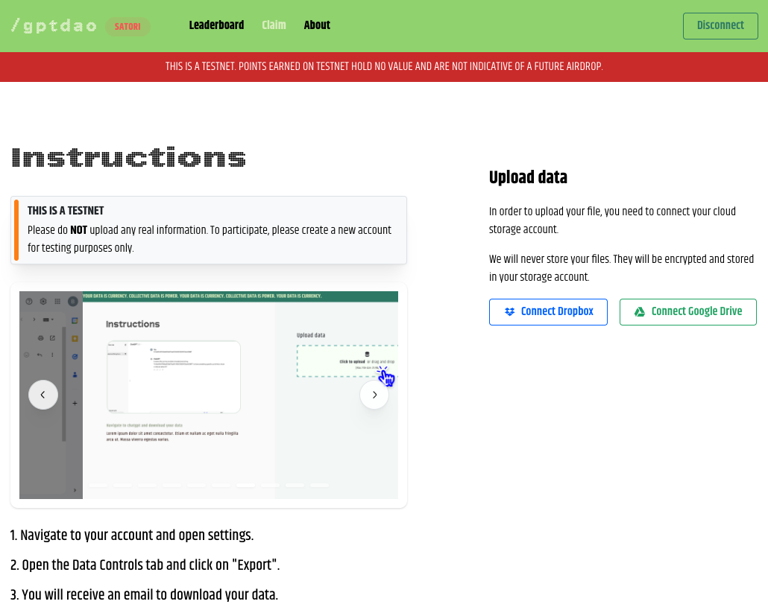
A data contributor can contribute to the ChatGPT DataDAO by uploading their ChatGPT exports at gptdatadao.org
Updated 5 months ago
* * *
---
# Contract Addresses
VANA Token Address
[](#vana-token-address)
----------------------------------------------
VANA is the native token of Vana mainnet, so there is no token address.
| Network | Contract address |
| --- | --- |
| Vana mainnet | Native gas token |
VANA Across Chains
[](#vana-across-chains)
----------------------------------------------
VANA is also available as an ERC-20 token across chains, following the OFT standard.
| Network | Contract address |
| --- | --- |
| Ethereum | [https://etherscan.io/token/0x7ff7fa94b8b66ef313f7970d4eebd2cb3103a2c0](https://etherscan.io/token/0x7ff7fa94b8b66ef313f7970d4eebd2cb3103a2c0) |
| Base | [https://basescan.org/token/0x7ff7fa94b8b66ef313f7970d4eebd2cb3103a2c0](https://basescan.org/token/0x7ff7fa94b8b66ef313f7970d4eebd2cb3103a2c0) |
| Arbitrum | [https://arbiscan.io/token/0x7ff7fa94b8b66ef313f7970d4eebd2cb3103a2c0](https://arbiscan.io/token/0x7ff7fa94b8b66ef313f7970d4eebd2cb3103a2c0) |
| BNB Smart Chain | [https://bscscan.com/token/0x7ff7fa94b8b66ef313f7970d4eebd2cb3103a2c0](https://bscscan.com/token/0x7ff7fa94b8b66ef313f7970d4eebd2cb3103a2c0) |
| Optimism | [https://optimistic.etherscan.io/token/0x7ff7fa94b8b66ef313f7970d4eebd2cb3103a2c0](https://optimistic.etherscan.io/token/0x7ff7fa94b8b66ef313f7970d4eebd2cb3103a2c0) |
| Polygon | [https://polygonscan.com/token/0x7ff7fa94b8b66ef313f7970d4eebd2cb3103a2c0](https://polygonscan.com/token/0x7ff7fa94b8b66ef313f7970d4eebd2cb3103a2c0) |
Please note there may be other tokens with the name $VANA that are not associated with Vana, malicious or otherwise. Be careful and make sure that the token you are interacting with is the correct one.
Relevent Tokens on Vana Mainnet
[](#relevent-tokens-on-vana-mainnet)
------------------------------------------------------------------------
| Token | Contract address |
| --- | --- |
| USDC.e | 0xF1815bd50389c46847f0Bda824eC8da914045D14 |
| Vana OFT | 0x7FF7Fa94b8b66Ef313f7970d4EEbd2CB3103a2C0 |
| Wrapped ETH | 0x2F6F07CDcf3588944Bf4C42aC74ff24bF56e7590 |
| Wrapped Vana | 0x00EDdD9621Fb08436d0331c149D1690909a5906d |
| USDT | 0x88853D410299BCBfE5fCC9Eef93c03115E908279 |
To explore data tokens, visit the Data Hub.
Updated 4 months ago
* * *
---
# ChatGPT DataDAO Example
###
How it works in the ChatGPT DataDAO
[](#how-it-works-in-the-chatgpt-datadao)
In the ChatGPT DataDAO, they rely on the email from OpenAI linking the user to their export to verify the authenticity of the data.
* User requests a data export of their ChatGPT data.
* Once they receive the "Your export is ready email", they download the zip file and copy the download link from the email.
* In gptdatadao.org, along with uploading their zip file, they are asked to provide the download link. Both are encrypted such that only a DataDAO validator can see them.
* The DataDAO validator receives the encrypted file and download link. They download and decrypt the file from the user's storage, as well as the one provided in the link. They calculate a checksum of both files and ensure they match, ensuring the zip that's uploaded to the user's storage has not been tampered with.
###
Implementation
[](#implementation)
A model influence function is implemented that fingerprints a data point and compares it to other data points on the network.
* The validator calculates a feature vector of the zip file by first getting a deterministic string representation of the file, and converting it to a feature vector. This is the fingerprint of that data point. If a slightly altered file is ran through this same process, it will produce a very similar fingerprint, unlike a hash, which will be vastly different even if 1 bit of the underlying data is changed.
* The validator then records this on-chain so other validators are aware of the fingerprints of other data points in the network. They then build a local vector store of all existing data points.
* After the fingerprint is calculated, it inserts the fingerprint into the local vector store and checks how similar it is to other fingerprints in the store. If it is too similar, it will reject the data point.
This method offers an efficient way to check similarity against all other files in the network. If you'd like to use this in your DataDAO, see [here](https://github.com/vana-com/vana-dlp-chatgpt/blob/main/tests/similarity.py)
for an example.
###
Explanation
[](#explanation)
Let’s use the ChatGPT DataDAO as an example to explain how the Proof of Contribution process works in practice:
* **Authenticity Check**
* **Mechanism:** Contributors upload their ChatGPT data exports.
* **Verification:** The validator compares the checksum of the uploaded export file with the checksum of the file provided via OpenAI’s download link, ensuring no tampering has occurred.
* **Ownership Verification**
* **Mechanism:** In the ChatGPT DataDAO, ownership is validated through metadata included in the data export. This metadata links the data to the user’s OpenAI account.
* **Simplified Check:** A simple confirmation via email or an associated account link can serve as an ownership check.
* **Quality Evaluation**
* **Mechanism:** The validator takes sample conversations from the exported data and evaluates them using a language model (e.g., OpenAI’s GPT).
* **Scoring:** The conversations are scored for coherence and relevance, with an overall quality score assigned to the data.
* **Uniqueness Check**
* **Mechanism:** A model influence function fingerprints the data and compares it against previously submitted datasets.
* **Preventing Duplicates:** If the fingerprint is too similar to existing data, the submission is flagged as a duplicate and rejected.
Updated 5 months ago
* * *
---
# Ecosystem Partners
* [Stargate](https://stargate.finance/)
- cross-chain bridge
* [DataDEX](https://datadex.com/)
- DEX
* [Quicknode](https://www.quicknode.com/)
- RPC provider
* [Gelato](https://www.gelato.network/relay)
- gassless transactions
* [Tally](https://www.tally.xyz/)
- DAO governance
* [Snapshot](https://snapshot.org/#/)
- DAO governance
* [Graph](https://thegraph.com/)
- indexing and subgraphs
* [Immunefi](https://immunefi.com/)
- bounty program
* [Goldsky](https://goldsky.com/)
- indexing and subgraphs
* [Chainstack](https://chainstack.com/)
- RPC provider
* [Para](https://www.getpara.com/)
- cross-app embedded wallets
* [Hyperlane](https://hyperlane.xyz/)
- cross-chain bridge
* [Orbiter](https://orbiter.finance/)
- cross-chain swap
* [Reclaim Protocol](https://reclaimprotocol.org/)
- zkTLS
* [Phala](https://phala.network/)
- TEEs network
* [Nethermind](https://www.nethermind.io/)
- audit
* [Hashlock](https://hashlock.com/)
- audit
* [DEXScreener](https://dexscreener.com/)
- token trading
* [Defined](https://defined.fi/)
- token trading
* [Safe](https://safe.global/)
- multisig
Updated about 1 month ago
* * *
---
# Bridging on Vana
Vana has integrated into the [**LayerZero**](https://layerzero.network/)
ecosystem to provide seamless asset transfers across multiple chains. Our primary bridge is [**Stargate**](https://stargate.finance/)
, which will be publicly available for all users on our public launch
Supported Assets
[](#supported-assets)
------------------------------------------
The table below shows the supported routes for each asset type. **USDC.e** is a bridged version of USDC that will be convertible to native USDC once Circle completes its integration. On the Vana network, **ETH** from chains where it’s native will automatically convert to **WETH**, and **WETH** will convert back to native **ETH** when bridging out.
| **Protocol/Chain** | **Vana** | **USDC.e** | **USDT** | **WETH/ETH** |
| --- | --- | --- | --- | --- |
| **Ethereum** | Yes | Yes | Yes | Yes |
| **Optimism** | Yes | Yes | Yes | Yes |
| **Arbitrum** | Yes | Yes | Yes | Yes |
| **Base** | Yes | Yes | \- | Yes |
| **Avalanche** | Yes | Yes | Yes | \- |
| **Polygon** | Yes | Yes | Yes | \- |
| **Binance Smart Chain** | Yes | Yes | Yes | \- |
| **Aurora** | \- | Yes | \- | \- |
| **Core Chain** | \- | Yes | Yes | \- |
| **Flare** | \- | Yes | Yes | Yes |
| **Gravity** | \- | Yes | Yes | Yes |
| **IOTA** | \- | Yes | Yes | Yes |
| **Kaia** | \- | Yes | Yes | Yes |
| **Lightlink** | \- | Yes | Yes | Yes |
| **Mantle** | \- | Yes | Yes | Yes |
| **Peaq** | \- | Yes | \- | Yes |
| **Scroll** | \- | Yes | \- | Yes |
| **SEI** | \- | Yes | Yes | Yes |
| **TAIKO** | \- | Yes | Yes | \- |
| **Linea** | \- | \- | \- | Yes |
| **Metis** | \- | \- | Yes | Yes |
| **Rari Chain** | \- | Yes | Yes | \- |
| **EBI** | \- | \- | Yes | \- |
| **Kava** | \- | \- | Yes | \- |
Simplified Asset Information
[](#simplified-asset-information)
------------------------------------------------------------------
* **Vana**: The Vana native token is built using the [**OFT** standard](https://docs.layerzero.network/v2/home/token-standards/oft-standard)
from LayerZero. This standard allows Vana to operate seamlessly across multiple blockchains without requiring a wrapped version.
* **USDC.e**: A version of USDC specifically bridged for use on certain chains. In the future, Circle’s integration will allow easy conversion between USDC.e and native USDC, making transfers even more flexible.
* **USDT**: The widely-used stablecoin that’s verified and deployed by Stargate, ensuring secure and reliable transfers across multiple chains.
* **WETH/ETH**: On networks where ETH is the native token (e.g., Ethereum), it will be automatically wrapped into WETH when transferred to the Vana network. Conversely, WETH from the Vana network will be unwrapped back into ETH when bridging to chains where ETH is native.
Updated 4 months ago
* * *
---
# Network
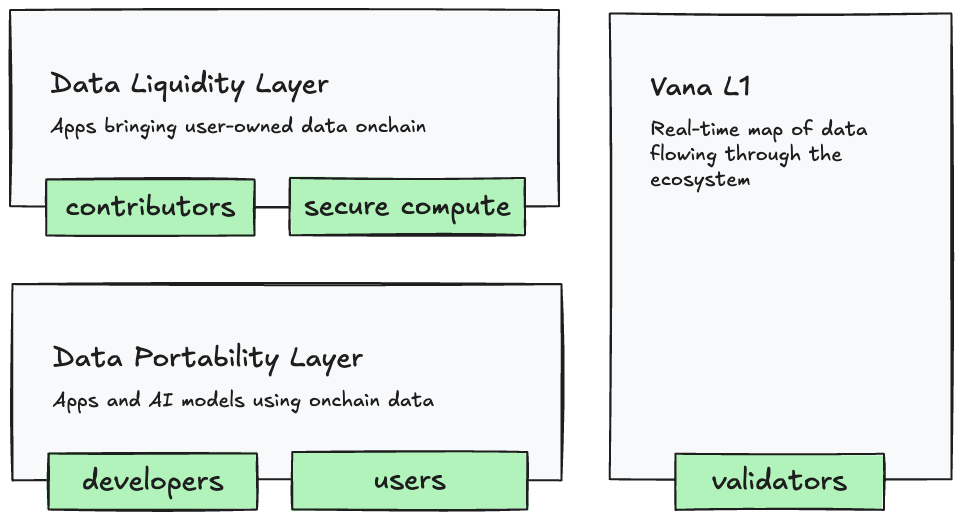
Vana is a decentralized data network designed to unlock the value of private, user-owned data. The network consists of two primary layers that ensure data ownership, security, and usability:
* **Data Liquidity Layer**, where [DataDAOs](https://docs.vana.org/docs/data-liquidity-pools-dlps)
operate. Designed to introduce data on-chain as transferable digital assets.
* **Data Portability Layer** for user-owned data applications powered by verified data.
The Vana L1 is used as a permissionless, real-time map of data flowing through the ecosystem.
Data Liquidity Layer
[](#data-liquidity-layer)
--------------------------------------------------
###
Overview
[](#overview)
The Data Liquidity Layer is the foundational layer in Vana that enables data to be treated as a liquid asset. It allows data to be securely validated, tokenized, and traded through decentralized mechanisms. This layer introduces **DataDAOs**, which aggregate similar types of data from various contributors, creating decentralized, trustless markets for data.
###
Key Functions
[](#key-functions)
* **Data Validation:** Data submitted by contributors is validated using the [Proof of Contribution (PoC)](https://docs.vana.org/docs/proof-of-contribution)
mechanism, ensuring the authenticity, ownership, quality, and uniqueness of the data.
* **Data Tokenization:** Once validated, data is tokenized and can be traded or used within the network. Each DataDAO issues its own tokens, rewarding contributors for providing valuable data.
* **Trading and Governance:** DataDAO tokens allow users to participate in data governance and trade data as an asset within the Vana ecosystem.
###
DataDAOs
[](#datadaos)
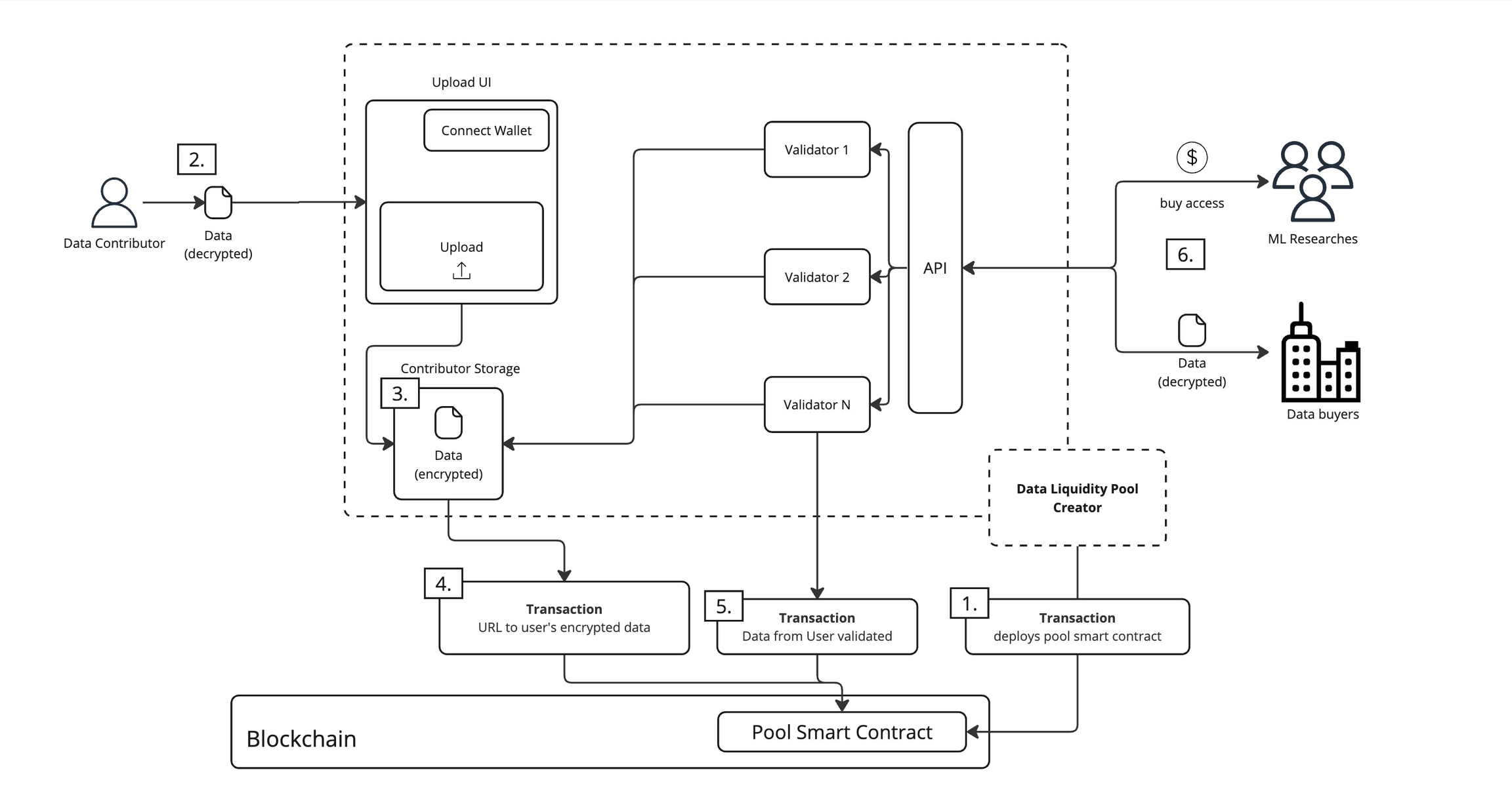
DataDAOs act as decentralized marketplaces for data:
* Data Contributors submit their data to DataDAOs and receive governance rights and rewards.
* Data is verified in the Satya network, a cluster of secure compute nodes, also known as Data Validators, ensuring the quality and integrity of the data.
* Data Consumers can access these validated datasets for AI training or other use cases.
* DataDAOs incentivize high-quality data contributions and provide transparent mechanisms for data use and training.
Data Portability Layer
[](#data-portability-layer)
------------------------------------------------------
###
Overview
[](#overview-1)
The Data Portability Layer is the application layer of Vana, enabling decentralized datasets to be accessed, shared, and used across various platforms and applications. This layer ensures that user-owned data remains interoperable across different services and systems while maintaining privacy and security.
###
Key Functions
[](#key-functions-1)
* **Cross-Application Data Sharing:** This layer enables seamless movement of data between applications while maintaining full user control. Users can authorize which applications access their data, ensuring privacy and security.
* **Interoperability:** The layer is designed to be compatible with multiple platforms, protocols, and applications, enabling data to be used across ecosystems. For example, AI models trained on Vana’s decentralized datasets can be accessed by various AI applications.
* **Governance & Access Control:** Data owners retain control over their data, including deciding how it is used and by whom. Contributors can also participate in governance through DataDAO tokens, which allows them to influence decisions on how data is shared.
###
Decentralized Applications (dApps)
[](#decentralized-applications-dapps)
The Data Portability Layer supports decentralized applications (dApps) that can interact with validated datasets:
* **AI Models:** Developers can build AI models that access and train on decentralized datasets, ensuring ethical use of data.
* **Data-Driven Apps:** Applications that rely on user-generated data can leverage Vana’s secure and interoperable datasets to provide better user experiences and data insights.
This layer ensures that data remains useful and accessible across the decentralized web, unlocking its full potential for users and developers.
Updated 20 days ago
* * *
---
# Minimum Requirements
> ### 📘
>
> Compliance Update:
>
> To qualify for rewards and maintain eligibility in the Vana ecosystem, DataDAOs must meet the updated requirements outlined in **[VRC-5](https://github.com/vana-com/VRCs/blob/main/VRCs/vrc-5.md)
> , [VRC-14](https://github.com/vana-com/VRCs/blob/main/VRCs/vrc-14.md)
> , [VRC-15](https://github.com/vana-com/VRCs/blob/main/VRCs/vrc-15.md)
> , and [VRC-20](https://github.com/vana-com/VRCs/blob/main/VRCs/vrc-20.md)
> .** These standards ensure that DataDAOs contribute meaningful data, maintain liquidity, and comply with best practices.
* * *
🔍 **Verification Strategy**
[](#-verification-strategy)
------------------------------------------------------------
* * *
###
🛡️ **1\. Proof of Contribution Standards**
[](#️-1-proof-of-contribution-standards)
DataDAOs must establish and publish their **proof-of-contribution (PoC)** process to ensure that contributed data adheres to the following principles:
* **Authenticity:** Data must be verified as genuine and untampered to build trust across the ecosystem.
* **Ownership:** Contributors must have legitimate ownership of the data they submit.
* **Quality:** Data should meet high standards of accuracy and relevance to maintain the integrity of the pool.
* **Uniqueness:** Contributions must be distinct and non-duplicative to avoid redundancies and ensure diversity of data.
> ### 📘
>
> Helpful Resource
>
> Explore the [template repository](https://github.com/vana-com/vana-satya-proof-template-py)
> for implementing a proof-of-contribution rules.
* * *
###
🔗 **2\. Data Refinement & Query Architecture**
[](#-2-data-refinement--query-architecture)
To meet VRC-15 standards, DataDAOs must:
* ✅ **Add a Refinement Step to PoC:**
* Refine raw data contributions to an encrypted, structured format.
* Publish refinement schemas to the **DataRefinerRegistry.**
* ✅ **Publish Data Schema Onchain:**
* Document the SQL schema and Docker image used in the refinement process.
* Ensure the schema is accessible for query engines.
* ✅ **Enable Query Access:**
* Grant permissioned access to refined data with well-defined pricing models.
* * *
###
🔗 **3\. VRC-20 Token Standards**
[](#-3-vrc-20-token-standards)
All DataDAOs must launch a **compliant token** to qualify for rewards. Minimum VRC-20 standards include:
* ✅ **Fixed or Predictable Schedule:** No unlimited minting or rebase functions.
* ✅ **Vesting for Team Allocations:** At least **6 months** of vesting, unlocking linearly thereafter.
* ✅ **Transfer Fee Cap:** No transfer fees exceeding **3%.**
* ✅ **Verified Source Code:** Token contracts must be verified on [Vanascan](https://vanascan.io/)
.
* * *
🌐 **Media and Communication Requirements**
[](#-media-and-communication-requirements)
------------------------------------------------------------------------------------------
* * *
###
📢 **1\. Web Presence**
[](#-1-web-presence)
* Maintain an **active, publicly accessible website** that provides clear information about your DataDAO’s mission, progress, and contributor incentives.
* * *
###
🗣️ **2\. Public Communication Channels**
[](#️-2-public-communication-channels)
* Engage contributors and the community through active channels such as **Twitter, Discord, or Telegram.**
* Share regular updates to ensure transparency and foster community trust.
* * *
###
💬 **3\. Social Media Engagement**
[](#-3-social-media-engagement)
* Build a strong presence in relevant online communities.
* Encourage data contributors and token holders to stay informed about your DataDAO’s growth and incentives.
* * *
💡 **Contributor Interface and Documentation**
[](#-contributor-interface-and-documentation)
------------------------------------------------------------------------------------------------
* * *
###
🖥️ **1\. Data Contributor Interface**
[](#️-1-data-contributor-interface)
* Provide an easy-to-use interface for data submission.
* Supported interfaces can include:
* A web app
* A browser extension
* A Telegram bot
* Any other user-friendly tool.
* * *
###
📚 **2\. Data Schema Documentation**
[](#-2-data-schema-documentation)
* Publish detailed documentation outlining the format and schema of the data being collected.
* Ensure contributors and data consumers can easily understand the dataset’s structure.
* * *
📊 **On-Chain Metrics & Minimum Thresholds**
[](#-on-chain-metrics--minimum-thresholds)
-------------------------------------------------------------------------------------------
* * *
###
🔥 **1\. Minimum Contributor Threshold**
[](#-1-minimum-contributor-threshold)
* DataDAOs must have at least **100 unique contributors** with verified files recorded on-chain.
* Contributors must call the [addProof](https://vanascan.io/address/0x8C8788f98385F6ba1adD4234e551ABba0f82Cb7C?tab=write_proxy#c26045f7)
method in the [DataRegistry](https://vanascan.io/address/0x8C8788f98385F6ba1adD4234e551ABba0f82Cb7C)
.
* **Tip:** Use Vana’s [TEEs](https://docs.vana.org/docs/proof-of-contribution)
that automatically publish proofs after data verification.
> ### 📘
>
> Tip
>
> Check out our example [Vana DLP UI](https://github.com/vana-com/vana-dlp-ui-tee-template)
> example repository to follow the full file verification path on the Vana network.
* * *
###
💸 **2\. Minimum Liquidity**
[](#-2-minimum-liquidity)
To prevent excessive slippage during buy-ins, DataDAOs must maintain sufficient liquidity:
* **Initial Liquidity:** Seed enough starting liquidity in your VANA/DataDAO trading pair.
* **Monitor Slippage:** Keep slippage as low as possible.
* **Add Liquidity as Needed:** Scale liquidity gradually as trading volume increases.
> ### 📘
>
> Tip:
>
> Regularly monitor DEX pool activity to prevent excessive price fluctuations and slippage.
🚀 **For DataDAO Creators: Submit Your Readiness**
[](#-for-datadao-creators-submit-your-readiness)
-------------------------------------------------------------------------------------------------------
By meeting these requirements, your DataDAO remains eligible for rewards and contributes to a stronger, more transparent Vana ecosystem.
**✅ Ready to confirm compliance?**
Submit your information [here](https://usevana.typeform.com/to/iU0dCZ6P)
or contact us in the [Discord](https://discord.gg/vanabuilders)
.
> ### 📘
>
> Verification Hours:
>
> Verification is available during normal Pacific business hours Monday through Friday (9 am–5 pm).
>
> There is a blackout period **48 hours before the closure of the active rewards period.**
Updated 20 days ago
* * *
---
# Data Liquidity Pool & DLPToken
A Data Liquidity Pool (DLP) is a core component of the Vana ecosystem, designed to transform raw data into a liquid asset. It functions as a smart contract on the Vana blockchain that allows users to monetize, control, and govern their data in a decentralized manner. Each DataDAO can have its own token, providing contributors with ongoing rewards and governance rights.
The Data Registry, TEE Pool, and DLP Root contracts are a part of the Vana core smart contracts and do not need to be deployed by DataDAO builders. For testing and integration, you should use the addresses deployed on Moksha.
However, you will need to deploy your own Data Liquidity Pool & DLPToken (either the template version suggested by us, or your own version). Keep in mind that to be part of the Vana ecosystem and qualify for the DataDAO rewards program, the DLP contract needs to be integrated with Data Registry and DLP Root.
> ### 📘
>
> Available on Github
>
> [https://github.com/vana-com/vana-dlp-smart-contracts](https://github.com/vana-com/vana-dlp-smart-contracts)
Updated 5 months ago
* * *
---
# L1 Validator
###
Overview
[](#overview)
L1 Validators are responsible for maintaining the Vana Layer 1 blockchain's security and consensus through a Proof-of-Stake (PoS) mechanism. At launch, these nodes will be run and operated by professional node operators and reputable institutions (PoSA), given the importance of prioritizing network stability and data security. As the network matures and achieves greater utilization, Vana plans to transition to a permissionless validator set in phases, aligning with the vision of a decentralized, user-owned data future.
For more details, refer to the [Validator Setup documentation](https://github.com/vana-com/vana-private?tab=readme-ov-file#validator-setup)
.
###
Key Responsibilities:
[](#key-responsibilities)
* **Block Production:** L1 Validators propose new blocks and ensure their validity, adding them to the blockchain.
* **Transaction Validation:** Validators confirm that transactions are legitimate, preventing double-spending or malicious activity.
* **Network Security:** Validators maintain the integrity of the blockchain by staking VANA tokens, which serve as collateral. Misbehavior, such as attempting to validate fraudulent transactions, can result in penalties (slashing) to their stake.
* **Finalization:** Validators ensure the finality of transactions and the immutability of data on the blockchain.
How It Works:
* **Staking:** Validators are required to stake VANA tokens as collateral. The more VANA tokens staked, the higher the chance to propose and validate blocks. Max effective balance is 35K Vana.
* **Consensus Mechanism:** The network uses a Proof-of-Stake (PoS) mechanism, where validators are chosen to propose blocks based on the size of their stake.
* **Block Rewards:** Validators earn rewards in VANA tokens for their role in securing the network and validating transactions.
* **Penalties for Misbehavior:** Validators that act maliciously or fail to perform their duties are penalized through slashing, reducing their staked VANA tokens.
###
Hardware Requirements:
[](#hardware-requirements)
To operate efficiently and maintain the network, L1 Validators must meet specific hardware standards:
* **Testnet**
* 2-core CPU
* 8 GB RAM
* 100 GB SSD
* x86-64 architecture
* **Mainnet**
* 8-core CPU
* 32 GB RAM
* 1.2 TB SSD
* x86-64 architecture
Updated 20 days ago
* * *
---
# VanaPool
The VanaPool protocol offers a flexible, yield-generating staking ecosystem built on the Vana blockchain. It creates a marketplace where users can stake their VANA tokens into various entities, each with its own risk profile, APY settings, and reward structure, allowing for diversification across investment options while maintaining liquidity.
At its core, VanaPool implements a share-based tokenization system where stakers receive shares proportional to their contribution, with share prices that dynamically adjust based on accumulated rewards. This mechanism ensures fair reward distribution regardless of when users enter or exit the pool. The protocol features continuous compounding of rewards, calculated using advanced mathematical formulas to maximize yield generation.
VanaPool employs a tiered permission system with clearly defined roles for administrators, maintainers, and users, ensuring protocol security while enabling operational flexibility. The contracts are designed to be upgradeable using the UUPS pattern, allowing for future improvements without disrupting existing user positions or requiring migration of assets.
The architecture separates concerns across specialized contracts - entity management, staking operations, and treasury functions - creating a robust ecosystem that can evolve over time while maintaining core functionality. Each component is built with comprehensive security features including pause mechanisms, slippage protection, and reentrancy guards to protect user assets in all market conditions.
Updated 16 days ago
* * *
---
# Data Registry
The data registry contract functions as a central repository for managing all data within the network, functioning as a comprehensive file catalog. It allows users to add new files to the system, with each file receiving a unique identifier for future reference.
The contract manages access control for these files, enabling file owners to grant specific addresses permission to access their files. It also handles the storage of file metadata, including any offchain proofs or attestations related to file validation, which can include various metrics such as authenticity, ownership, and quality scores. Users can retrieve detailed information about any file in the registry using its unique identifier, including its permissions and associated proofs.
> ### 📘
>
> Contract Address
>
> **Moksha:** [0x8C8788f98385F6ba1adD4234e551ABba0f82Cb7C](https://moksha.vanascan.io/address/0x8C8788f98385F6ba1adD4234e551ABba0f82Cb7C)
>
> **Vana Mainnet:** [0x8C8788f98385F6ba1adD4234e551ABba0f82Cb7C](https://vanascan.io/address/0x8C8788f98385F6ba1adD4234e551ABba0f82Cb7C)
Updated 4 months ago
* * *
---
# Cycle 6 Rewards Distribution Example
Let’s walk through an example of DataDAO Alpha:
1. **Epoch 6 Ends:**
* DataDAO Alpha reports:
* **$5M trading volume** for its token.
* **1,000 unique contributors.**
* **$10,000 in data access fees.**
* All DataDAOs report:
* **$25M trading volume** for its token.
* **20,000 unique contributors.**
* **$100,000 in data access fees.**
* Total DataDAO pool is **300,000 VANA** for the epoch.
2. **Scoring Breakdown:**
* Trading Volume: 5M / 25M = **20% of pool** (30% weight).
* Unique Contributors: 1,000 / 20,000 = **5% of pool** (20% weight).
* Data Access Fees: 10K / 100K = **10% of pool** (50% weight).
* **DataDAO Alpha Score:**
0.30 × 20% + 0.20 × 5% + 0.50 × 10% = 12% of the rewards pool.
3. **Reward Allocation:**
* 12% × 300,000 VANA = **36,000 VANA allocated to DataDAO Alpha.**
4. **Daily Buy-In Deployment:**
* 36,000 VANA ÷ 91 days = **396 VANA daily.**
* Each day, VANA Foundation buys DataDAO Alpha tokens for 198 $VANA and adds liquidity to the DEX pool alongside with 198 $VANA
Feel free to check out the spreadsheet for the calculation of rewards: [Rewards Calculator](https://docs.google.com/spreadsheets/d/11tGf3qrFGreIDab9DnIFR-fbKUqNhFCA6RNvGtitqhM/edit?gid=1743325465#gid=1743325465)
Updated 20 days ago
* * *
---
# VanaPool Entity
VanaPoolEntity serves as the central registry for all yield-generating entities within the protocol, maintaining their status, reward pools, and configuration settings. It calculates rewards using a sophisticated continuous compounding formula that accurately reflects time-based accumulation.
The contract implements dynamic share pricing that automatically adjusts based on rewards processed, ensuring that all stakers receive fair value regardless of when they enter or exit. Entity owners can contribute additional rewards to their pools, which are distributed proportionally to stakers according to their share ownership.
VanaPoolEntity also handles entity lifecycle management including registration, updates, and status changes, while enforcing protocol rules such as minimum stake requirements and valid naming conventions.
> ### 📘
>
> Contract Address
>
> **Moksha:** [0x44f20490A82e1f1F1cC25Dd3BA8647034eDdce30](https://moksha.vanascan.io/address/0x44f20490A82e1f1F1cC25Dd3BA8647034eDdce30)
>
> **Vana Mainnet:** [0x44f20490A82e1f1F1cC25Dd3BA8647034eDdce30](https://vanascan.io/address/0x44f20490A82e1f1F1cC25Dd3BA8647034eDdce30)
Updated 16 days ago
* * *
---
# Cycle 2 Rewards Distribution Example
This example outlines the rewards distribution for Epoch 2 in the Vana protocol, shaped by the following VRCs:
* [VRC-2](https://github.com/vana-com/VRCs/blob/main/VRCs/vrc-2.md)
: Establishes performance metrics where 80% of rewards are based on stake and 20% on unique wallets contributing verified data.
* [VRC-3](https://github.com/vana-com/VRCs/blob/main/VRCs/vrc-3.md)
: Introduces a variable staking split, allowing DataDAOs to allocate 40%-60% of rewards to stakers.
* [VRC-4](https://github.com/vana-com/VRCs/blob/main/VRCs/vrc-4.md)
: Adds sublinear rewards for DataDAO creators, where rewards scale based on the square root of a DataDAO's score, benefiting smaller DataDAOs.
###
Key Variables
[](#key-variables)
* **epochRewardAmount:** Total rewards for the rewards cycle (e.g., 400,000 VANA).
* **stakersPercentage:** Percentage allocated to stakers (40%-60% per DataDAO).
* **epochDlpsLimit:** Maximum number of eligible DataDAOs (e.g., Top 16).
* **epochSize:** Length of one rewards cycle (e.g., 21 days).
###
$VANA Stakers Rewards
[](#vana-stakers-rewards)
1. **Calculate DataDAO Score**
A weighted calculation combining stake contribution and unique wallet activity.

2. **Calculate DataDAO Reward**
Rewards are proportional to the DataDAO's score.

3. **Calculate Stakers’ Share**
The stakers' share is based on the DataDAO's chosen stakersPercentage.

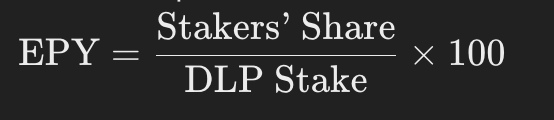
4. **Calculate EPY (Single Epoch Yield)**
EPY reflects the return for stakers in a single rewards cycle.
5. **Calculate APY (Annual Yield)**
APY scales the EPY to a full year.

###
DataDAO Creators Rewards
[](#datadao-creators-rewards)
1. **Calculate Overall Treasury Allocation**

2. **Calculate Adjusted Square Root of the DLP Score**

3. **Calculate Treasury Allocation for Each DLP**

**Example**
[](#example)
============================
###
Assumptions:
[](#assumptions)
* **Epoch Reward Amount**: 100,000 VANA.
* **DataDAOs**: 3 (DLP1, DLP2, DLP3)
* **Staker Percentages**: DLP1: **80%**, DLP2: **60%**, DLP3: **40%**.
* **Metrics Weights:** **80%** - total staked, **20%** - unique wallets
* **Performance Metrics**:
| DLP | Stake (VANA) | Unique Wallets |
| --- | --- | --- |
| DLP1 | 500,000 | 100 |
| DLP2 | 200,000 | 300 |
| DLP3 | 50,000 | 500 |
###
Stakers Calculations:
[](#stakers-calculations)
**Step 1:** Calculate DataDAO Score
| DataDAO | Formula | Result |
| --- | --- | --- |
| DLP1 | 80 × 500,000 ÷ 750,000 + 20 × 100 ÷ 900 = 53.33 + 2.22 | **55.56** |
| DLP2 | 80 × 200,000 ÷ 750,000 + 20 × 300 ÷ 900 = 21.33 + 6.67 | **28.00** |
| DLP3 | 80 × 50,000 ÷ 750,000 + 20 × 500 ÷ 900 = 5.33 + 11.11 | **16.44** |
**Step 2:** Calculate DataDAO Reward
| DataDAO | Formula | Result |
| --- | --- | --- |
| DLP1 | 55.56 ÷ (55.56 + 28.00 + 16.44) × 100,000 = 55.56 × 100,000 ÷ 100 | **55,556 VANA** |
| DLP2 | 28.00 ÷ (55.56 + 28.00 + 16.44) × 100,000 = 28.00 × 100,000 ÷ 100 | **28,000 VANA** |
| DLP3 | 16.44 ÷ (55.56 + 28.00 + 16.44) × 100,000 = 16.44 × 100,000 ÷ 100 | **16,444 VANA** |
**Step 3:** Calculate Stakers’ Share
| DataDAO | Formula | Result |
| --- | --- | --- |
| DLP1 | 55,556 × 80% = 55,556 × 0.8 | **44,445 VANA** |
| DLP2 | 28,000 × 60%= 28,000 × 0.6 | **16,800 VANA** |
| DLP3 | 16,444 × 40% = 16,444× 0.4 | **6,578 VANA** |
**Step 4:** Calculate EPY (Single Epoch Yield)
| DataDAO | Formula | Result |
| --- | --- | --- |
| DLP1 | 44,445 ÷ 500,000 × 100 = 8.89 | **8.89%** |
| DLP2 | 16,800 ÷ 200,000 × 100 = 8.40 | **8.40%** |
| DLP3 | 6,578 ÷ 50,000 × 100 = 13.16 | **13.16%** |
**Step 5:** Calculate APY (Annual Yield)
| DataDAO | Formula | Result |
| --- | --- | --- |
| DLP1 | 8.89 × (365 ÷ 21) = 154.48 | **154.48%** |
| DLP2 | 8.40 × (365 ÷ 21) = 145.98 | **145.98%** |
| DLP3 | 13.16 × (365 ÷ 21) = 228.57 | **228.57%** |
###
DataDAO Creators Calculations:
[](#datadao-creators-calculations)
Repeat **Step 1** and **Step 2** from Stakers Calculations
**Step 3:** Calculate Epoch Treasury Allocation
| DataDAO | Formula | Result |
| --- | --- | --- |
| DLP1 | 55,560 × (1 − 0.80) = 55,560 × 0.20 | 11,112 |
| DLP2 | 28,000 × (1 − 0.60) = 28,000 × 0.40 | 11,200 |
| DLP3 | 16,440 × (1 − 0.40) = 16,440 × 0.60 | 9,864 |
Treasury Allocation (Total) = 11,112 + 11,200 + 9,864 = **32,176** $VANA
**Step 4:** Calculate Adjusted Square Root of the DLP Score
| DataDAO | Formula | Result |
| --- | --- | --- |
| DLP1 | √55.56 \* (1 - 0.80) | 1.49 |
| DLP2 | √28.00 \* (1 - 0.60) | 2.12 |
| DLP3 | √16.44 \* (1 - 0.40) | 2.43 |
**Step 5:** Calculate Treasury Allocation for Each DLP
| DataDAO | Formula | Result |
| --- | --- | --- |
| DLP1 | 1.49 / 6.04 \* 32,176 | 7,943 |
| DLP2 | 2.12 / 6.04 \* 32,176 | 11,300 |
| DLP3 | 2.43 / 6.04 \* 32,176 | 12,933 |
###
Summary
[](#summary)
| DataDAO | Total Rewards | Stakers | Treasure |
| --- | --- | --- | --- |
| DLP1 | 52,391 | 44,448 | 7,943 |
| DLP2 | 28,100 | 16,800 | 11,300 |
| DLP3 | 19,509 | 6,576 | 12,933 |
Totals:
* **Total Rewards Distributed:** 52,391 + 28,100 + 19,509 = 100,000 $ VANA
* **Total Stakers' Rewards:** 44,448 + 16,800 + 6,576 = 67,824 $VANA
* **Total Treasury Rewards:** 7,943 + 11,300 + 12,933 = 32,176 $VANA
###
Key Insights
[](#key-insights)
* Each DataDAO can customize its stakers allocation within 40% - 60% range to balance treasury growth and staker incentives.
* If a DataDAO drops out of the **Top 16** or [Minimum Requirements](https://docs.vana.org/docs/minimum-requirements#/)
, it won't be eligible for rewards at the end of the epoch
* APY is an **annualized estimate** based on current conditions and may change within the epoch.
Updated 3 months ago
* * *
---
# FAQ
🧠 **General Questions**
[](#-general-questions)
----------------------------------------------------
* * *
###
**What is a** DLP?
[](#what-is-a-dlp)
A Data Liquidity Pool (DLP) is the technical term for a DataDAO. While "DataDAO" highlights the community and governance aspects, "DLP" focuses on the underlying mechanism that powers data liquidity.
* * *
###
**How do rewards work in the new system?**
[](#how-do-rewards-work-in-the-new-system)
Under the updated VRC-14 model, rewards are allocated to DataDAOs based on three key performance metrics:
1. **Token Trading Volume (30%)** – Reflects market activity and liquidity health.
2. **Unique Data Contributors (20%)** – Encourages diverse, high-quality contributions.
3. **Data Access Fees (50%)** – Measures real-world utility through data queries and fees.
Rewards are deployed **daily** in the form of VANA token buy-ins, which are used to purchase your DataDAO token and add liquidity to the DEX pool.
* * *
###
**What happens if my DataDAO doesn’t maintain liquidity?**
[](#what-happens-if-my-datadao-doesnt-maintain-liquidity)
To ensure that rewards can be deployed efficiently, DataDAOs must maintain **sufficient liquidity** in their token’s trading pool. If liquidity is too low:
* **Slippage Above 2%:** Buy-ins will be paused, and undeployed rewards may roll over to the next epoch.
* **Continued High Slippage:** If liquidity issues persist in the next epoch, unclaimed rewards are returned to the global pool.
**Tip:** To prevent slippage, maintain an initial liquidity pool of **$10K–$50K** and gradually scale as trading volume grows.
* * *
###
**What’s the difference between VRC-14, VRC-15, and VRC-20?**
[](#whats-the-difference-between-vrc-14-vrc-15-and-vrc-20)
Each VRC governs a different aspect of the new DataDAO ecosystem:
* **VRC-14:** Manages DataDAO incentives, aligning rewards with token liquidity, contributor engagement, and data access.
* **VRC-15:** Defines the data access architecture, requiring refined, encrypted data to be stored securely with verified query permissions.
* **VRC-20:** Specifies DataDAO token standards, including supply caps, vesting requirements, and transfer fees.
* * *
###
**What is Total Data Value Locked (TDVL), and why does it matter?**
[](#what-is-total-data-value-locked-tdvl-and-why-does-it-matter)
**TDVL** measures the total value of assets locked across DataFi applications on Vana. As TDVL grows, the reward pool increases to reflect the ecosystem’s success:
* **Base Pool:** 0.5% of VANA supply.
* **+0.5% Per $500M in TDVL:** Scales up to a maximum of **5% annually**.
* * *
🚀 **For DataDAO Creators**
[](#-for-datadao-creators)
----------------------------------------------------------
* * *
###
**How do I create a** DataDAO?
[](#how-do-i-create-a-datadao)
1. Use the [How to Create a DataDAO](https://docs.vana.org/docs/how-to-create-a-data-liquidity-pool#/)
guide to set up your pool.
2. Register the DataDAO by staking **100 $VANA** through the [DataDAO Root Contract](https://docs.vana.org/docs/dlp-root#/)
.
3. Pass [Minimum DataDAO Requrements](https://docs.vana.org/docs/minimum-requirements#/)
* * *
###
How can I have my DataDAO listed on Datahub?
[](#how-can-i-have-my-datadao-listed-on-datahub)
Your DataDAO will appear automatically after registering with **100 $VANA**. You can reach out to the Vana team to enhance it with metadata, such as icons.
* * *
###
**Can I de-register my** DataDAO?
[](#can-i-de-register-my-datadao)
Yes, you can de-register your DataDAO at any time. Your staked 100 $VANA will be returned immediately.
* * *
###
**How can I optimize my DataDAO for higher rewards?**
[](#how-can-i-optimize-my-datadao-for-higher-rewards)
To maximize rewards, focus on improving your performance across the three reward metrics:
1. **Boost Trading Volume:**
* Encourage organic market activity.
* Build deep liquidity and incentivize trading.
2. **Increase Unique Contributors:**
* Run targeted contributor campaigns.
* Incentivize diverse, high-quality data submissions.
3. **Maximize Data Access Fees:**
* Price query access competitively.
* Enable broader applications to leverage your data.
* * *
###
**How do I add liquidity to avoid slippage?**
[](#how-do-i-add-liquidity-to-avoid-slippage)
Maintaining healthy liquidity prevents excessive slippage during buy-ins. Follow these steps:
* **Initial Liquidity:** Seed at least **$10K–$50K** in your VANA/DataDAO trading pair.
* **Monitor Slippage:** Regularly assess slippage to ensure it stays below **2%.**
* **Adjust Liquidity as Needed:** As trading volume increases, scale liquidity incrementally to maintain optimal conditions.
* * *
###
**Can I modify my DataDAO after launch?**
[](#can-i-modify-my-datadao-after-launch)
Yes, DataDAOs can make updates to their contracts or governance structures to enhance functionality. However:
* **Token Contract Modifications:** Must comply with VRC-20, including implementing **48-hour timelocks** for major changes.
* **Proof-of-Contribution Updates:** Refinement scripts or data schemas can be modified and reflected in your UI for data contributors
* * *
###
**How do I maintain eligibility for future epochs?**
[](#how-do-i-maintain-eligibility-for-future-epochs)
To stay eligible for rewards in future epochs:
* ✅ **Comply with VRC-5, VRC-15, and VRC-20.**
* ✅ **Maintain Healthy Liquidity:** Ensure buy-ins stay below 2% slippage.
* ✅ **Track Token Price:** Prevent price drops exceeding **15%** from the reference price.
* * *
###
**What happens if my DataDAO token’s price drops?**
[](#what-happens-if-my-datadao-tokens-price-drops)
If your token’s price falls more than **15%** below the reference price (the average price during buy-ins):
* Buy-ins will be **paused** until market conditions stabilize.
* The Vana Foundation may conduct a review to assess liquidity and token health.
* **Tip:** Regularly monitor trading activity and maintain liquidity depth to prevent sudden price drops.
* * *
###
**Can I regain eligibility after missing compliance?**
[](#can-i-regain-eligibility-after-missing-compliance)
Yes, DataDAOs can regain eligibility by:
* **Resolving Non-Compliance:** Meet VRC-5, VRC-15, and VRC-20 requirements.
* **Re-establishing Liquidity:** If buy-ins were paused due to slippage or price drops, increase liquidity to resume buy-ins.
* **Submitting Updated Documentation:** Provide evidence of compliance to the Vana Foundation.
* * *
🔎 **Troubleshooting & Compliance**
[](#-troubleshooting--compliance)
-------------------------------------------------------------------------
* * *
###
**What happens if my DataDAO can’t maintain 2% slippage?**
[](#what-happens-if-my-datadao-cant-maintain-2-slippage)
If slippage exceeds **2%** during buy-ins:
* Buy-ins are **paused** temporarily.
* Unused rewards may roll over to the next epoch.
* If liquidity remains low in the next epoch, rewards may be returned to the global incentive pool.
**Tip:** To avoid this, maintain a minimum liquidity pool of **$50K–$100K** and adjust as trading volume grows.
* * *
###
**What if my contributors don’t meet PoC standards?**
[](#what-if-my-contributors-dont-meet-poc-standards)
Contributors play a key role in maintaining DataDAO eligibility. To ensure compliance:
* **Refine PoC Mechanisms:** Implement stricter validation and attestation.
* **Regularly Audit Contributions:** Monitor contributor activity for anomalies.
* **Communicate Compliance Standards:** Educate contributors on quality expectations.
* * *
###
**Can I change my DataDAO’s proof-of-contribution (PoC) after launch?**
[](#can-i-change-my-datadaos-proof-of-contribution-poc-after-launch)
Yes, but updates to your PoC should:
* **Follow Refinement Standards:** Publish schema and Docker images to the **DataRefinerRegistry**.
* **Notify the Vana Foundation:** Ensure transparency and compliance with onchain standards.
* * *
###
**What happens if my DataDAO misses an epoch?**
[](#what-happens-if-my-datadao-misses-an-epoch)
If your DataDAO doesn’t qualify for rewards in a given epoch:
* You won’t receive buy-ins during that epoch.
* Rewards may be restored in the following epoch if compliance is re-established.
* **Tip:** Address non-compliance quickly to prevent forfeiting future rewards.
* * *
📣 **Have More Questions?**
[](#-have-more-questions)
---------------------------------------------------------
If your question isn’t covered here, check out the following resources:
👉 [How to Create a DataDAO](https://docs.vana.org/docs/how-to-create-a-data-liquidity-pool#/)
👉 [Join the Vana Community on Discord](https://discord.gg/vanabuilders)
Updated 20 days ago
* * *
---
# TEE Pool
The Satya Network specializes in the validation of data contributions to DataDAOs, running their Proof of Contribution. These validators operate within a Trusted Execution Environment (TEE), ensuring that data can be validated securely and privately. This allows for privacy-preserving validation, where the data being processed is shielded from both the validator and external parties.
The TEE Pool contract manages and coordinates the TEE Validators and serves as an escrow for holding fees associated with validation tasks. Users pay a fee to submit data for validation, and the contract ensures that the validators process the data and provide proof of validation. The contract also allows the owner to add or remove validators, and it securely holds and disburses the fees related to these validation services.
> ### 📘
>
> Contract Address
>
> **Vana's Satya Network (powered by Intel SGX)**
>
> Moksha:[0x3c92fD91639b41f13338CE62f19131e7d19eaa0D](https://moksha.vanascan.io/address/0x3c92fD91639b41f13338CE62f19131e7d19eaa0D)
>
> Vana Mainnet: [0x3c92fD91639b41f13338CE62f19131e7d19eaa0D](https://vanascan.io/address/0x3c92fD91639b41f13338CE62f19131e7d19eaa0D)
>
> **Phala's Satya Network (powered by Intel TDX)**
>
> Moksha: [0xE8EC6BD73b23Ad40E6B9a6f4bD343FAc411bD99A](https://moksha.vanascan.io/address/0xE8EC6BD73b23Ad40E6B9a6f4bD343FAc411bD99A)
>
> Vana Mainnet: [0xE8EC6BD73b23Ad40E6B9a6f4bD343FAc411bD99A](https://vanascan.io/address/0xE8EC6BD73b23Ad40E6B9a6f4bD343FAc411bD99A)
Updated 3 months ago
* * *
---
# Smart Contracts
Smart contracts form the backbone of Vana's decentralized data economy by handling data registration, tokenization, rewards, and governance in a secure and transparent manner.
* [Data Registry](doc:data-registry)
: The data registry is the main entry point for data in the Vana network.
* [TEE Pool](doc:tee-pool)
: The TEE Pool orchestrates TEEs in the Satya Network.
* [VanaPool](vana-pool)
: VanaPool is a decentralized staking protocol that allows users to stake VANA tokens into different entities, earning continuously compounded rewards based on each entity's APY while maintaining their share ownership through a dynamic shares system.
* [VanaPoolEntity](doc:vana-pool-epoch)
: Manages yield-generating entities with configurable APY settings and reward distribution mechanisms.
* [VanaPoolStaking](doc:vana-pool-staking)
: Enables users to stake and unstake VANA tokens across different entities using a share-based accounting system.
* [VanaPoolTreasuty](doc:vana-pool-treasury)
: A secure vault contract that holds staked VANA tokens and manages their distribution when users unstake.
* [DLPRoot](dlp-root)
* [DLPRootEpoch](doc:dlp-root-epoch)
: Handles epoch-based operations including creation, finalization, and reward distribution for DLPs across time periods.
* [DLPRootCore](doc:dlp-root-core)
: Manages the DLP lifecycle including registration, verification, and stake management with eligibility thresholds.
* [DLPRootStaking](doc:dlp-root)
: Manages staking functionality including stake creation, withdrawal, migration, and reward.
* [DLPRootMetrics](doc:dlp-root-metrics)
: Calculates performance ratings and rewards for DLPs, determining top performers based on stake amounts and custom metrics.
* [DlpRootTreasuries](doc:dlp-root-treasuries)
: Manages staked and reward VANA tokens through separate treasuries for staking and reward distribution.
* [Data Liquidity Pool & DLP Token](doc:data-liquidity-pool-dlptoken)
: A DataDAO's implementation of how to tokenize data in the Vana network.
* [Multicall3](doc:multicall3)
: Enables batching multiple smart contract calls into a single transaction to optimize gas usage and execution efficiency.
* [Multisend](doc:multisend)
: Allows batch transfers of tokens or ETH to multiple addresses in a single transaction, reducing gas costs for bulk operations.
> ### 📘
>
> Available on Github
>
> [https://github.com/vana-com/vana-smart-contracts](https://github.com/vana-com/vana-smart-contracts)
> (all contracts)
>
> [https://github.com/vana-com/vana-dlp-smart-contracts](https://github.com/vana-com/vana-dlp-smart-contracts)
> (dlp creators contracts)
Updated 16 days ago
* * *
---
# Vana Docs

Page Not Found
--------------
---
# Release Notes
October 28th, 2024
improved
October 23rd, 2024
added
---
# DLP Root Epoch
The DLPRootEpoch contract manages the temporal structure of the Vana ecosystem through a system of epochs, which are fixed time periods (measured in blocks) during which DLPs can participate and earn rewards. It handles epoch creation, finalization, and the distribution of rewards to eligible DLPs based on their performance and stake amounts within each epoch.
Each epoch has a defined start and end block, a total reward amount to be distributed, and tracks participating DLPs along with their stake scores. The contract enables dynamic epoch creation, ensuring the system always has future epochs available for participation. When an epoch ends, it can be finalized, which locks in the participating DLPs and their metrics, and triggers the reward distribution process based on the stake scores and performance metrics from DLPRootMetrics.
The contract implements sophisticated reward calculation and distribution mechanisms that account for both the stake amount and performance rating of each DLP. It provides functions to query historical data about epochs and DLP participation, allowing for transparent tracking of rewards and performance over time. The epoch structure is configurable, with adjustable parameters like epoch size, reward amount, and maximum DLPs per epoch, providing flexibility to adapt the protocol as the ecosystem grows.
> ### 📘
>
> Contract Address
>
> **Moksha:** [0xc3d176cF6BccFCB9225b53B87a95147218e1537F](https://moksha.vanascan.io/address/0xc3d176cF6BccFCB9225b53B87a95147218e1537F)
>
> **Vana Mainnet:** [0xc3d176cF6BccFCB9225b53B87a95147218e1537F](https://vanascan.io/address/0xc3d176cF6BccFCB9225b53B87a95147218e1537F)
Updated 16 days ago
* * *
---
# Validators
Validators are crucial participants in the Vana ecosystem, responsible for maintaining the security, integrity, and functionality of the Vana Layer 1 blockchain. They ensure that data transactions are properly validated, recorded, and added to the blockchain.
Validators play two distinct roles within the Vana network:
* [L1 Validators](https://docs.vana.org/docs/l1-validators)
, who ensure blockchain security and consensus.
* [Satya Validators (Data Validators)](https://docs.vana.org/docs/tee-validators)
, who specialize in validating data contributions in DataDAOs through secure, trusted execution environments (TEEs).
Validators are rewarded in VANA tokens for their contribution to the network’s operation, with distinct reward mechanisms for L1 Validators and Satya Validators.
###
Summary
[](#summary)
####
L1 Validators:
[](#l1-validators)
* **Minimum Stake:** 35,000 $VANA per validator.
* **Initial Set:** 64 validators at launch, scaling to 128 over time.
* **Rewards:** Validators receive 5 $VANA per block. Rewards reduce annually by 10% to ensure sustainability.
* **Slashing:** 10% penalty for malicious behavior or significant downtime (>12 hours per epoch).
####
Satya Nodes:
[](#satya-nodes)
* **Role:** Provide Trusted Execution Environments (TEEs) for secure data validation.
* **Rewards:** Satya Nodes earn $VANA for validating data contributions and processing data access requests. Stakers to Data Validators are rewarded from these fees.
Updated 20 days ago
* * *
* [L1 Validators](/docs/l1-validators)
* [Satya Validators](/docs/tee-validators)
---
# Cycle 3-5 Rewards Distribution Example
This example outlines the rewards distribution for Epoch 3 in the Vana protocol, shaped by [VRC-8](https://github.com/vana-com/VRCs/blob/main/VRCs/vrc-8.md)
and [VRC-11](https://github.com/vana-com/VRCs/blob/main/VRCs/vrc-11.md)
###
Key Changes in Epoch 3
[](#key-changes-in-epoch-3)
* **Standardized APY for Stakers:** A single APY rate applies across all DLPs to prevent uneven incentives.
* **Removal of the 7-Day Unstaking Window:** Stakers can now move their stakes dynamically without waiting periods
* **Removal of Sublinear Formula For DataDAO Creators:** Rewards for creators are now determined by the linear formula, as it was in epoch 1.
* **100% Stake-Based Rewards:** Unique contributor-based rewards have been removed, and all rewards are determined by stake.
* **Time-Weighted Staking Adjustments for Stakers and DataDAOs:** The ranking of the top 16 DLPs is now determined by the updated scoring model, which accounts for adjusted short-term staking to prevent last-minute manipulation
###
Key Variables
[](#key-variables)
* **epochRewardAmount:** Total rewards for the rewards cycle (e.g., 400,000 VANA).
* **stakersPercentage:** Percentage allocated to stakers (50% per DataDAO).
* **epochDlpsLimit:** Maximum number of eligible DataDAOs (e.g., Top 16).
* **epochSize:** Length of one rewards cycle (e.g., 21 days).
###
$VANA Stakers Rewards
[](#vana-stakers-rewards)
1. **Calculate Adjusted Stake for DLP Score**
At this step, we apply time-weighting for stakes under 21 days, ensuring late stakers contribute less to the DLP Score.
 
2. **Calculate DataDAO Score**
Each DLP’s Score is now based on the Total Adjusted Stake from Step 1..

3. **Calculate DataDAO Reward**
Rewards are proportional to the DataDAO's score.

4. **Calculate Stakers’ Share**
The stakers' share is based on the DataDAO's chosen stakersPercentage.

4. **Calculate EPY (Single Epoch Yield)**
EPY reflects the return for stakers in a single rewards cycle.

5. **Calculate APR**
APR scales the EPY to a full year.
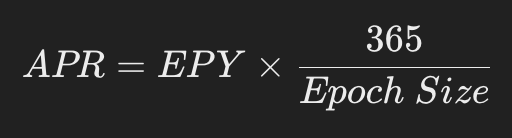
6. **Calculate APY**
APY represents the return on staked assets if rewards are continuously staked and compounded at the end of each epoch for a full year.

###
DataDAO Creators Rewards
[](#datadao-creators-rewards)
With VRC-11, sublinear rewards are removed, and DataDAO rewards are now fully proportional to stake weight.

**Example**
[](#example)
============================
###
Assumptions:
[](#assumptions)
* Epoch Reward Amount = 400,000 VANA
* DataDAOs = DLP1, DLP2, DLP3
* Staker Percentage = 50% for all DLPs
* Time-Weighted Staking:
* DLP1 received 1 stake that is staked for 1 day
* DLP2 received 2 stakes (staked for 5 days and 10 days)
* DLP3 received 3 stakes (staked for 7 days, 15 days, and 25 days)
###
Stakers Calculations:
[](#stakers-calculations)
**Step 1:** Calculate Adjusted Stake for DLP Score
| DataDAO | Staked Amount | Days Staked | Multiplier | Formula | Adjusted Stake |
| --- | --- | --- | --- | --- | --- |
| DLP1 | 300,000 | 1 day | 1/21 | 300,000 × 1 / 21 | **14,285.71** |
| DLP2 | 400,000 | 5 days | 5/21 | 400,000 × 5 / 21 | **95,238.10** |
| DLP2 | 600,000 | 10 days | 10/21 | 600,000 × 10 / 21 | **285,714.29** |
| DLP3 | 250,000 | 7 days | 7/21 | 250,000 × 7 / 21 | **83,333.33** |
| DLP3 | 500,000 | 15 days | 15/21 | 500,000 × 15 / 21 | **357,142.86** |
| DLP3 | 100,000 | 25 days | 1x | 100,000 × 1 | **100,000** |
Summary of total adjusted stakes per DataDAO:
| DataDAO | Formula | Result |
| --- | --- | --- |
| DLP1 | 14,285.71 | **14,285.71** |
| DLP2 | 95,238.10 + 285,714.29 | **380,952.38** |
| DLP3 | 83,333.33 + 357,142.86 + 100,000 | **540,476.1** |
**Step 2:** Calculate DataDAO Score
| DataDAO | Formula | Result |
| --- | --- | --- |
| DLP1 | 14,285.71 / 935,714.28 | **0.0152** |
| DLP2 | 380,952.38 / 935,714.28 | **0.4071** |
| DLP3 | 540,476.1 / 935,714.28 | **0.5776** |
**Step 3:** Calculate DataDAO Rewards
| DataDAO | Formula | Result |
| --- | --- | --- |
| DLP1 | 0.0152 × 400,000 | **6,120 VANA** |
| DLP2 | 0.4071 × 400,000 | **162,880 VANA** |
| DLP3 | 0.5776 × 400,000 | **231,000 VANA** |
**Step 4:** Calculate Stakers' Share
| DataDAO | Formula | Result |
| --- | --- | --- |
| DLP1 | 6,120 × 50% | **3,060 VANA** |
| DLP2 | 162,880 × 50% | **81,440 VANA** |
| DLP3 | 231,000 × 50% | **115,500 VANA** |
###
DataDAO Creators Calculations:
[](#datadao-creators-calculations)
| DataDAO | Formula | Result |
| --- | --- | --- |
| DLP1 | 6,120 − 49,120 | **3,060 VANA** |
| DLP2 | 162,880 − 62,360 | **81,440 VANA** |
| DLP3 | 231,000 − 88,520 | **115,500 VANA** |
###
Stakers Calculations:
[](#stakers-calculations-1)
**Step 1:** Calculate Stakes Scores
| DataDAO | Staked Amount | Days Staked | Multiplier | Formula | Stake Score |
| --- | --- | --- | --- | --- | --- |
| DLP1 | 300,000 | 1 day | 1/21 | 300,000 × 1 / 21 | **14,285.71** |
| DLP2 | 400,000 | 5 days | 5/21 | 400,000 × 5 / 21 | **95,238.10** |
| DLP2 | 600,000 | 10 days | 10/21 | 600,000 × 10 / 21 | **285,714.29** |
| DLP3 | 250,000 | 7 days | 7/21 | 250,000 × 7 / 21 | **83,333.33** |
| DLP3 | 500,000 | 15 days | 15/21 | 500,000 × 15 / 21 | **357,142.86** |
| DLP3 | 100,000 | 25 days | 1.1x | 100,000 × 1.1 | **110,000** |
**Step 2:** Summarize Scores per DataDAO
| DataDAO | Formula | Result |
| --- | --- | --- |
| DLP1 | 14,285.71 | **14,285.71** |
| DLP2 | 95,238.10 + 285,714.29 | **380,952.38** |
| DLP3 | 83,333.33 + 357,142.86 + 110,000 | **550,476.19** |
**Step 3:** Calculate Rewards
| DataDAO | Staked Amount | Stake Score | Formula | Adjusted Stake |
| --- | --- | --- | --- | --- |
| DLP1 | 300,000 | 14,285.71 | 14,285.71 / 14,285.71 / 3,060 | **3,060 VANA** |
| DLP2 | 400,000 | 95,238.10 | 95,238.10 / 380,952.38 / 81,440 | **20,360 VANA** |
| DLP2 | 600,000 | 285,714.29 | 285,714.29 / 380,952.38 / 81,440 | **61,080 VANA** |
| DLP3 | 250,000 | 83,333.33 | 83,333.33 / 550,476.19 / 115,500 | **17,470 VANA** |
| DLP3 | 500,000 | 357,142.86 | 357,142.86 / 550,476.19 / 115,500 | **74,900 VANA** |
| DLP3 | 100,000 | 110,000 | 110,000 / 550,476.19 / 115,500 | **23,130 VANA** |
This new structure for Cycle 3 ensures fairer, more sustainable staking and DataDAO participation while aligning with ecosystem goals. 🚀
Updated 20 days ago
* * *
---
# Proof of Contribution
###
Overview
[](#overview)
The Proof of Contribution (PoC) mechanism in Vana is designed to validate data in a decentralized, privacy-preserving manner. It ensures that only authentic, high-quality, and unique data is added to DataDAOs, allowing contributors to benefit from the value their data generates, while protecting their privacy.
###
Key Elements of PoC
[](#key-elements-of-poc)
* **Authenticity:** Ensures that the data is real and unaltered.
* **Ownership:** Confirms the data belongs to the contributor.
* **Quality:** Measures the relevance and utility of the data.
* **Uniqueness:** Prevents redundant or copied data from being reused.
###
How It Works
[](#how-it-works)
* **Data Submission:** Contributors submit encrypted data to a DataDAO, which is stored off-chain with metadata written on-chain.
* **Validation:** Validators use a secure Trusted Execution Environment (TEE) to check the data for authenticity, ownership, quality, and uniqueness via **Proof Of Contribution**.
* **Attestation & Reward:** Once validated, an attestation (proof) is generated and recorded on-chain. Contributors are rewarded in VANA tokens based on their data's quality.
###
Implementation
[](#implementation)
One recommended implementation for DataDAO Proof-of-Contribution is to run a [model influence function](https://www.vana.org/posts/model-influence-functions-measuring-data-quality)
, which measures exactly how much new information a given data point teaches the AI model.
###
Customization
[](#customization)
Each DataDAO in Vana can implement its own PoC function based on the data it handles. For example:
* **Financial Data DataDAO:** May prioritize the timeliness and accuracy of data.
* **Social Media Data DataDAO:** May focus on engagement metrics or user activity.
By customizing the PoC function, DataDAO creators ensure that their data pools are filled with meaningful, relevant, and high-quality contributions.
###
Benefits
[](#benefits)
* **Data Quality:** Guarantees that data within DataDAOs is trustworthy and useful for AI training or other purposes.
* **Privacy:** Contributors can submit and validate data without exposing sensitive information.
* **Incentivization:** Contributors are rewarded in VANA tokens based on the quality and uniqueness of their data.
* **Governance**: PoC provides a fair system for contributors to earn governance rights in DataDAOs.
###
Zero-Knowledge Proof (ZKP) Integration
[](#zero-knowledge-proof-zkp-integration)
To enhance privacy, Vana uses Zero-Knowledge Proofs. This allows contributors to prove that their data meets certain criteria (e.g., more than 50 conversations in the ChatGPT DataDAO) without revealing the actual content. The cryptographic proof is generated in a secure browser environment, ensuring that sensitive data is never exposed.
For example, a user might submit a proof that their dataset contains a valid number of conversations without revealing the exact contents of those conversations. Validators process the ZKP and confirm the submission’s validity without accessing the raw data.
Updated 5 months ago
* * *
---
# DLP Root Core
The DLPRootCore contract manages the lifecycle of Delegation Liquidity Providers (DLPs) in the Vana ecosystem, handling registration, verification, and eligibility status. It serves as the central registry for all DLPs, storing critical information such as their addresses, ownership details, stake amounts, and verification status, which determine their eligibility to participate in the ecosystem.
The contract implements a tiered eligibility system with configurable thresholds that determine whether a DLP can participate in epochs and receive rewards. DLPs can be in various states including Registered, Eligible, SubEligible, or Deregistered, with transitions between these states triggered by changes in stake amounts or administrative actions. The eligibility mechanism ensures that only DLPs meeting minimum stake requirements and verification standards can actively participate in the protocol.
A key feature of the contract is its historical data tracking using checkpoints, which record stake amounts and staker reward percentages at different points in time. This allows for accurate historical queries when calculating rewards for past epochs. The contract also manages the distribution between staker and owner rewards through configurable percentages, balancing incentives for both DLP operators and their stakers while maintaining security through comprehensive role-based access controls.
> ### 📘
>
> Contract Address
>
> **Moksha:** [0x0aBa5e28228c323A67712101d61a54d4ff5720FD](https://moksha.vanascan.io/address/0x0aBa5e28228c323A67712101d61a54d4ff5720FD)
>
> **Vana Mainnet:** [0x0aBa5e28228c323A67712101d61a54d4ff5720FD](https://vanascan.io/address/0x0aBa5e28228c323A67712101d61a54d4ff5720FD)
Updated 16 days ago
* * *
---
# VanaPool Staking
VanaPoolStaking provides the user-facing interface for interacting with the protocol, allowing participants to stake their VANA tokens into any active entity. It manages the issuance and redemption of entity shares, which represent proportional ownership in an entity's staking pool.
The contract implements comprehensive slippage protection mechanisms to prevent value extraction during high volatility periods, ensuring users receive fair value during both stake and unstake operations. It supports flexible staking options including the ability to designate different recipients for shares, enabling delegation and custody solutions.
VanaPoolStaking maintains detailed records of all user positions across different entities, enabling portfolio diversification while preserving accurate accounting. It coordinates closely with VanaPoolEntity to ensure that reward processing occurs at critical moments such as stake or unstake operations.
> ### 📘
>
> Contract Address
>
> **Moksha:** [0x641C18E2F286c86f96CE95C8ec1EB9fC0415Ca0e](https://moksha.vanascan.io/address/0x641C18E2F286c86f96CE95C8ec1EB9fC0415Ca0e)
>
> **Vana Mainnet:** [0x641C18E2F286c86f96CE95C8ec1EB9fC0415Ca0e](https://vanascan.io/address/0x641C18E2F286c86f96CE95C8ec1EB9fC0415Ca0e)
Updated 16 days ago
* * *
---